
Lubricating, cleaning and tensioning a motorcycle chain: every method compared
Grease or oil the chain, chain spray or chain oiler, wax or gear oil, every 500 km or not at all: few maintenance topics on a motorcycle are debated as relentlessly as caring for the drive chain. The short answer first: if you cover a lot of miles, mostly on the road, an automatic chain oiler is the most economical option and needs the least attention. If you ride little, chain spray works well, as long as you lubricate regularly. In rough terrain, dirt determines wear, not the lubrication method. And not lubricating at all significantly shortens chain life, even on sealed chains.
Almost every method has its followers, and under certain conditions almost every one of them works. This comparison classifies all common methods by their working principle and adds measured values, experience-based values for chain life and recommendations for each riding profile and motorcycle. It also covers the jobs that are part of chain care: cleaning, adjusting tension and recognising when the chain and sprocket kit is due. We are not neutral here: BEROTEC makes a chain oiler of its own, the MOFESSOR. Measured values, manufacturer's figures and experience-based values are therefore labelled separately, and every method is presented with its limitations, the chain oiler included.
Contents
- How is a motorcycle chain constructed?
- How does a motorcycle chain wear?
- How do you measure chain wear?
- How do you adjust a motorcycle chain correctly?
- Which material is best for the rear sprocket?
- What chain lubrication methods are there?
- How much lubricant does the chain need?
- How do you lubricate a chain with chain spray?
- How do you oil a chain by hand?
- Which oil is suitable for a motorcycle chain and a chain oiler?
- What types of automatic chain oiler are there?
- What do measurements show about continuous and interval lubrication?
- Is hot waxing any good for a motorcycle chain? (niche)
- Other niche methods
- What happens if you never lubricate the chain?
- How environmentally friendly are the methods?
- How do you clean a motorcycle chain?
- How do you look after the chain without a centre stand?
- How long does a motorcycle chain last?
- What is proven and what is not
- Which chain lubrication suits which riding profile?
- Which chain lubrication suits which motorcycle?
- Enclosed chain case, toothed belt or shaft drive: can you do without chain care?
- Myths and half-truths about the motorcycle chain
- Frequently asked questions about chain lubrication
- Frequently asked questions about wear, tensioning and costs
- Sources
How is a motorcycle chain constructed?
A motorcycle chain is a roller chain. The outer plates are pressed onto the pins, the inner plates onto the bushes. The rollers run on the bushes and roll along the teeth of the front and rear sprocket as they engage. On sealed chains, elastomer seals sit between the inner and outer plates and enclose the factory grease that is packed between pin and bush. Depending on the cross-section of these seals, chains are classed as O-ring, X-ring and Z-ring chains. X-rings and Z-rings have several sealing lips and run with less friction than the round O-ring. Non-sealed chains without seals are found today mainly in motocross and on small-capacity motorcycles.

Construction of a sealed chain.
In the cutaway link, the seals sit between the inner and outer plates and enclose the grease between pin and bush.
Construction of a sealed chain.
In the cutaway link, the seals sit between the inner and outer plates and enclose the grease between pin and bush.
The designation 520, 525 or 530 describes the geometry. The first digit gives the pitch in eighths of an inch, so for all three it is 5/8 inch or 15.875 mm from pin centre to pin centre. The last two digits stand for the inner width: 1/4, 5/16 and 3/8 inch. Small bikes run 420 or 428 chains with a 1/2 inch pitch, i.e. 12.7 mm.
How does a motorcycle chain wear?
A motorcycle chain wears in three places: in the joint between pin and bush, between bush and roller, and at the tooth engagement on the front and rear sprocket. It does not actually stretch. What is measured as chain elongation is material worn away in the joint between pin and bush. Each time the chain goes round the front and rear sprocket, the pin turns a little inside the bush, and over tens of thousands of revolutions the play in every single joint adds up to a measurably longer chain. The plates themselves remain unchanged.
The three friction points wear independently of one another. On a sealed chain, the joint between pin and bush is lubricated exclusively by the factory grease; nothing from outside reaches it. As long as the seals are intact, wear at this point is low. The other two are between bush and roller and at the tooth engagement between roller and tooth. The tooth engagement is where the force is transmitted, and it is also where dirt collects. Both points lie outside the seal and depend on external lubrication. In practice, they usually decide when a chain and sprocket kit reaches the end of its life. The seals also need the external film: without it they dry out under UV radiation and ozone, become brittle and crack. If the grease then escapes, the joint runs dry and elongation at that point increases rapidly. External lubrication therefore only acts on the joint indirectly, by protecting the seals. A joint that is running dry can be recognised by reddish-brown powder emerging at the seal. This is fretting corrosion: without grease, pin and bush rub directly against each other and the fine wear debris oxidises. Chain manufacturers such as Tsubaki and Wippermann cite this discolouration of the joints as a sign of inadequate lubrication. Unlike surface rust, which covers the plates evenly and can be wiped off, fretting corrosion is localised at individual joints and comes back after cleaning. A joint like this cannot be saved.

Mud clogs the chain, rear sprocket and swingarm. Under conditions like these, dirt determines wear, not the lubrication method.
Besides lubrication, other factors determine wear, and the biggest is dirt. Dust, sand and mud combine with any lubricant to form a grinding paste that attacks rollers and teeth. Water displaces the lubricant film, and road salt considerably accelerates corrosion on plates and rollers. High chain temperatures promote wear, and warm grease escapes more easily past damaged seals. A chain that is too tight puts strain on the bearings and gearbox output shaft; one that is too slack slaps and whips. If the front and rear sprocket are not aligned, plates and tooth flanks wear on one side and the seals are loaded sideways. Small front sprockets increase the articulation angle per revolution and the force per tooth. At the same gearing, the chain and sprocket kit therefore wears faster than with a larger front sprocket. Worn cush drive rubbers in the rear wheel turn every load change into a hammer blow at the tooth engagement, and riding style and engine power play their part too. Our own long-term test showed how much a single assembly fault can matter: a front sprocket nut that had not been tightened correctly at the factory let the front sprocket run with play, and it wore prematurely. Because every roller passes over the front sprocket on every revolution, the rollers of the entire chain wore along with it.
A motorcycle chain wears in three places: in the joint between pin and bush, between bush and roller, and at the tooth engagement on the front and rear sprocket. It does not actually stretch. What is measured as chain elongation is material worn away in the joint between pin and bush. Each time the chain goes round the front and rear sprocket, the pin turns a little inside the bush, and over tens of thousands of revolutions the play in every single joint adds up to a measurably longer chain. The plates themselves remain unchanged.
The three friction points wear independently of one another. On a sealed chain, the joint between pin and bush is lubricated exclusively by the factory grease; nothing from outside reaches it. As long as the seals are intact, wear at this point is low. The other two are between bush and roller and at the tooth engagement between roller and tooth. The tooth engagement is where the force is transmitted, and it is also where dirt collects. Both points lie outside the seal and depend on external lubrication. In practice, they usually decide when a chain and sprocket kit reaches the end of its life. The seals also need the external film: without it they dry out under UV radiation and ozone, become brittle and crack. If the grease then escapes, the joint runs dry and elongation at that point increases rapidly. External lubrication therefore only acts on the joint indirectly, by protecting the seals. A joint that is running dry can be recognised by reddish-brown powder emerging at the seal. This is fretting corrosion: without grease, pin and bush rub directly against each other and the fine wear debris oxidises. Chain manufacturers such as Tsubaki and Wippermann cite this discolouration of the joints as a sign of inadequate lubrication. Unlike surface rust, which covers the plates evenly and can be wiped off, fretting corrosion is localised at individual joints and comes back after cleaning. A joint like this cannot be saved.
Mud clogs the chain, rear sprocket and swingarm. Under conditions like these, dirt determines wear, not the lubrication method.
Besides lubrication, other factors determine wear, and the biggest is dirt. Dust, sand and mud combine with any lubricant to form a grinding paste that attacks rollers and teeth. Water displaces the lubricant film, and road salt considerably accelerates corrosion on plates and rollers. High chain temperatures promote wear, and warm grease escapes more easily past damaged seals. A chain that is too tight puts strain on the bearings and gearbox output shaft; one that is too slack slaps and whips. If the front and rear sprocket are not aligned, plates and tooth flanks wear on one side and the seals are loaded sideways. Small front sprockets increase the articulation angle per revolution and the force per tooth. At the same gearing, the chain and sprocket kit therefore wears faster than with a larger front sprocket. Worn cush drive rubbers in the rear wheel turn every load change into a hammer blow at the tooth engagement, and riding style and engine power play their part too. Our own long-term test showed how much a single assembly fault can matter: a front sprocket nut that had not been tightened correctly at the factory let the front sprocket run with play, and it wore prematurely. Because every roller passes over the front sprocket on every revolution, the rollers of the entire chain wore along with it.
| Wear pattern | Possible cause | Remedy |
|---|---|---|
| Chain can be pulled well away from the rear sprocket | Chain elongated, teeth worn | Replace the complete chain and sprocket kit |
| Hooked, asymmetrical teeth | Elongated chain has worn the sprockets as well | Replace the complete chain and sprocket kit |
| Running noise that rises and falls rhythmically, jerking or pulsing at constant speed | Chain unevenly elongated | Measure elongation at several points, adjust at the tightest point, usually replace the kit |
| Individual stiff links | Lack of lubrication, corrosion, faulty seal | Clean and lubricate; if the link stays stiff, replace |
| Plates or tooth flanks worn bright on one side | Front and rear sprocket not aligned | Check and correct alignment |
| Chain adjusters at the end of their range | Elongation exceeds the adjustment range | Replace the chain and sprocket kit, do not remove links |
| Chain slaps against the swingarm | Chain too slack or chain slider worn | Adjust tension, replace chain slider |
| Chain jumps off the rear sprocket | Chain too slack, badly elongated, teeth worn or misaligned | Fix the cause and inspect the chain and sprocket kit, do not simply refit the chain |
| Chain needs adjusting unusually often | advanced elongation | Measure elongation, plan for a new chain and sprocket kit |
| Chain snatches on load changes, rear wheel has play at the rear sprocket | Cush drive worn | Check and replace cush drive rubbers |
| Reddish-brown powder at individual joints that returns after cleaning | Fretting corrosion: seal faulty, grease escaped, joint running dry | cannot be repaired, replace chain and sprocket kit |
| Surface rust on the plates | no lubricant film after rain or a period of standing | wipe off and lubricate; localised rust at the joints, by contrast, is fretting corrosion |
How do you measure chain wear?
Chain wear is measured mainly via elongation, supplemented by the pull-off test and a look at the teeth. D.I.D gives the limit as 1% of chain length for sealed chains and 2% for non-sealed chains. Measure on the taut run with a vernier calliper or steel rule over as many links as possible, from pin centre to pin centre. With a 5/8 inch pitch, a new chain measures exactly 317.5 mm over 20 pitches, i.e. from pin 1 to pin 21. An elongation of 1% corresponds to around 320.7 mm there. New chains can deviate slightly from the nominal dimension when measured; in our long-term test the new dimension was 318.0 mm. The most accurate approach is therefore to measure against your own chain's starting value. Because chains wear unevenly, it is worth measuring at several points. If the vehicle handbook specifies its own limit, that limit applies.
Elongation alone does not tell the whole story, though. Rollers and teeth wear independently and can finish off a chain and sprocket kit long before the elongation limit is reached. The pull-off test serves as a quick check without tools: pull the chain rearwards away from the rear sprocket at the height of the rear axle. If more than about half the tooth height becomes visible, the chain is worn. The result depends heavily on the number of teeth on the rear sprocket, however, and is only a rough guide. Always check the tooth shape as well. Chain slack, on the other hand, says nothing about wear. It only describes the current tension, and an elongated chain can be adjusted just as correctly as a new one.
Chain, front sprocket and rear sprocket are always replaced as a set. An elongated chain wears the teeth into hooks, and a new chain on worn sprockets climbs the teeth and wears out in a short time. D.I.D and RK explicitly recommend replacing them together. For mid-range bikes the parts cost around €80 to €170; with fitting by a workshop, €200 or more is quickly reached. When fitting, the new chain is cut to length with a breaker and riveting tool and closed with a rivet link or clip link. With a clip link, the open end of the spring clip faces against the direction of travel. The grease on a new chain does not need to be removed before fitting; it protects against corrosion and lubricates for the first few kilometres.

Left, a front sprocket from a Yamaha XT 600 after around 36,000 km; right, a new one. The teeth of the old one are narrow, pointed and worn into hooks.
Chain wear is measured mainly via elongation, supplemented by the pull-off test and a look at the teeth. D.I.D gives the limit as 1% of chain length for sealed chains and 2% for non-sealed chains. Measure on the taut run with a vernier calliper or steel rule over as many links as possible, from pin centre to pin centre. With a 5/8 inch pitch, a new chain measures exactly 317.5 mm over 20 pitches, i.e. from pin 1 to pin 21. An elongation of 1% corresponds to around 320.7 mm there. New chains can deviate slightly from the nominal dimension when measured; in our long-term test the new dimension was 318.0 mm. The most accurate approach is therefore to measure against your own chain's starting value. Because chains wear unevenly, it is worth measuring at several points. If the vehicle handbook specifies its own limit, that limit applies.
Elongation alone does not tell the whole story, though. Rollers and teeth wear independently and can finish off a chain and sprocket kit long before the elongation limit is reached. The pull-off test serves as a quick check without tools: pull the chain rearwards away from the rear sprocket at the height of the rear axle. If more than about half the tooth height becomes visible, the chain is worn. The result depends heavily on the number of teeth on the rear sprocket, however, and is only a rough guide. Always check the tooth shape as well. Chain slack, on the other hand, says nothing about wear. It only describes the current tension, and an elongated chain can be adjusted just as correctly as a new one.
Left, a front sprocket from a Yamaha XT 600 after around 36,000 km; right, a new one. The teeth of the old one are narrow, pointed and worn into hooks.
Chain, front sprocket and rear sprocket are always replaced as a set. An elongated chain wears the teeth into hooks, and a new chain on worn sprockets climbs the teeth and wears out in a short time. D.I.D and RK explicitly recommend replacing them together. For mid-range bikes the parts cost around €80 to €170; with fitting by a workshop, €200 or more is quickly reached. When fitting, the new chain is cut to length with a breaker and riveting tool and closed with a rivet link or clip link. With a clip link, the open end of the spring clip faces against the direction of travel. The grease on a new chain does not need to be removed before fitting; it protects against corrosion and lubricates for the first few kilometres.
How do you adjust a motorcycle chain correctly?
The correct chain tension is given in the vehicle handbook and, on many motorcycles, also on a sticker on the swingarm. It is specified as chain slack, i.e. how far the lower run of the chain can be moved up and down midway between the front and rear sprocket. On road bikes it is usually between 20 and 40 mm; on enduros and adventure bikes with long suspension travel it is considerably more. Measure in the position the handbook specifies, usually on the side stand or on a stand and without a rider. Because chains wear unevenly, turn the wheel and measure at several points. The tightest point is what counts. An unevenly elongated chain also gives itself away while riding, because it jerks or pulses at constant speed. If it is adjusted at a slack point, it will be too tight at the tightest point.
To adjust the chain, loosen the rear axle nut and pull the wheel back by the same amount on both sides using the chain adjusters. The marks on the swingarm help to align the wheel straight but are not always accurate. An alignment tool or a look along the chain shows whether the front and rear sprocket are aligned. Then tighten the axle nut to the torque given in the handbook, lock the adjusters and check the slack once more. A chain that is too tight does more harm than one that is slightly too slack: as the suspension compresses, it tightens further and puts strain on the gearbox output shaft, bearings and chain. Workshops usually charge for chain adjustment as a minor job based on time; there is no standard guide price.
How often the chain needs adjusting depends directly on wear, because every millimetre of elongation shows up as additional slack. A new chain should be checked after the first few kilometres, then at every lubrication or roughly every 500 to 1,000 km. With a chain oiler, the chain elongates more slowly and needs adjusting much less often. In our experience, an intact chain with an oiler usually goes from one tyre change to the next without adjustment, and it gets set anyway when the wheel is refitted. In our long-term test, after 15,836 km the oiler chain showed around a third less elongation than the spray chain, despite the high proportion of dirt. On the road, in our experience, the gap is larger. If a chain suddenly needs adjusting at short intervals, that is a sign of advanced wear, and elongation should be measured.
Which material is best for the rear sprocket?
A steel rear sprocket is the cheapest and the longest-lasting; aluminium saves weight. Hybrid sprockets with a steel toothed ring combine both. Because the front sprocket almost always wears first, in our experience even a good aluminium sprocket usually lasts as long as the chain and sprocket kit. The front sprocket is practically always made of hardened steel. It has the fewest teeth, and therefore the largest articulation angle and the highest load per tooth. Many original-equipment front sprockets have rubber-coated contact flanks that reduce running noise. With the rear sprocket, on the other hand, you have a choice, and it comes down to a trade-off between weight and service life.
Steel rear sprockets are the heaviest, the cheapest and the longest-lasting. Aluminium rear sprockets, in good quality made from 7075 and hard-anodised, save weight and therefore unsprung mass, but wear faster than steel. This matters less often than is commonly assumed. The front sprocket has the fewest teeth and is usually the first to wear out, and because the chain and sprocket kit is replaced as a whole, in our experience a good aluminium sprocket usually lasts until the next change. In rough terrain with sand and mud and on high-torque touring bikes, steel remains the safer choice. Hybrid rear sprockets such as the Supersprox Stealth or Renthal Twinring combine an aluminium core with a steel toothed ring, pairing the low weight of aluminium with the service life of steel. In return, they are the most expensive. There are no reliable, manufacturer-independent mileage figures for any of the three materials. Figures in forums vary widely.
| Feature | Steel | Aluminium (7075, hard-anodised) | Hybrid (aluminium core, steel toothed ring) |
|---|---|---|---|
| Weight | high | low | low, just above aluminium |
| Service life | longest, often several chains | shorter than steel, usually one chain and sprocket kit (experience-based value) | comparable to steel (manufacturer's figure) |
| Price | low | medium | high |
| Behaviour in sand and mud | robust | rapid wear | robust |
| Typical use | Road, touring, adventure bike | Track, motocross, road with weight in mind | Sport, touring and enduro with weight in mind |
What chain lubrication methods are there?
The methods can be divided into six groups: chain spray, wax and dry lubricants, oil applied by hand, mechanically or manually triggered chain oilers, electronically controlled chain oilers and hot waxing. Hot waxing and a few other methods play hardly any role on motorcycles and are marked as niche.
| Method | Lubricant film | Range per application | Effort | Dirt pick-up | Mess on the motorcycle | Behaviour in rain | Running costs |
|---|---|---|---|---|---|---|---|
| Chain spray (tacky grease, oil) | heavy after application, then decreasing | 300 to 800 km according to the handbook, considerably less in rain | high | high | high: overspray and tacky grease on rim, swingarm and front sprocket area | medium | medium |
| Wax and dry lubricants | thin, decreasing | shorter than tacky grease, considerably shorter in the wet | high | low | low | weak | medium |
| Oil by hand (brush, bottle, bristle brush) | good, decreasing | similar to chain spray, shorter in rain | high | medium | medium: excess is flung off | medium | low |
| Chain oiler, mechanically or manually triggered | continuous, depending on triggering and temperature | one reservoir fill, depending on reservoir and setting | medium | medium | low to medium, depending on the dosage | good | low |
| Chain oiler, electronically controlled | continuously replenished | one reservoir fill, 5,000 to 10,000 km with the MOFESSOR | low after installation | medium | low to medium, depending on the dosage | good, with increased dosage | low |
| Hot wax / paraffin (niche) | clean, not very effective on sealed chains | short, very short in the wet | very high | low | low | weak | low |
| No lubrication at all | none | – | none | low | low | poor (corrosion) | none, but very high chain wear |
How much lubricant does the chain need?
With every method, the right amount lies in a window between too little and too much, and both edges have clear signs. Too little can be recognised by a dull, greyish surface, the first signs of surface rust and a dry, rattling run. The rollers turn less freely, the tooth engagement wears faster and unprotected seals dry out. This damage cannot be undone. Too much is flung off and ends up on the rim, the swingarm and, in the worst case, the tyre sidewall. Any excess also binds dirt. Lubricant and dust then turn into a grinding paste, and the benefit of lubrication is reversed.
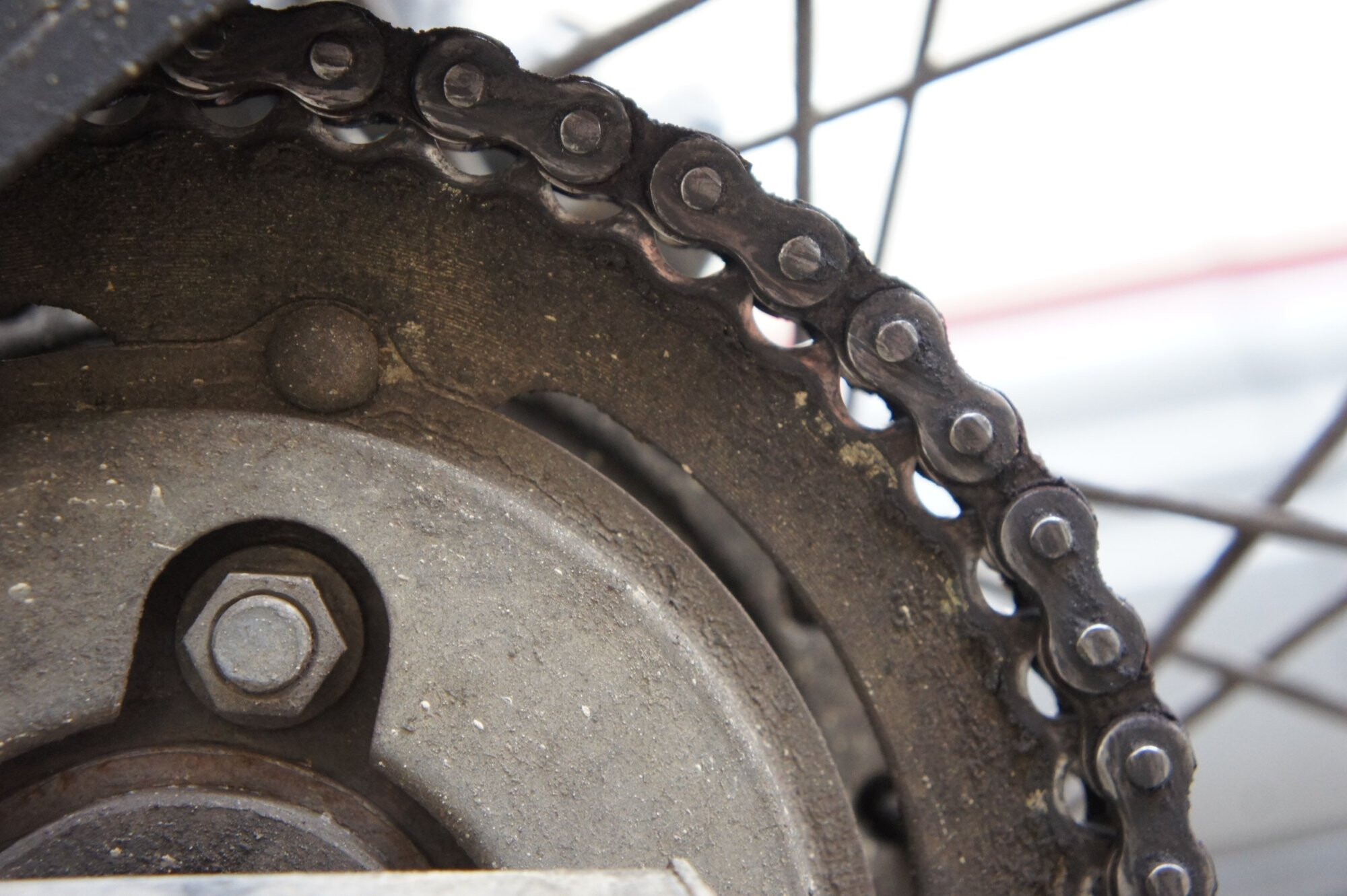
Too little lubrication: the chain is dull and dry, with dust on the plates and rear sprocket.

Lubricant and dirt have baked into a crust on the chain and rear sprocket. This is how lubricant turns into a grinding paste.
Too little lubrication: the chain is dull and dry, with dust on the plates and rear sprocket.
Lubricant and dirt have baked into a crust on the chain and rear sprocket. This is how lubricant turns into a grinding paste.
What you want is a thin, continuously moist film on the rollers and plate edges: wetted but not dripping, and with no crust. This is easy to check with the engine off: run a finger over the rollers. It should feel oily, but nothing should stick to your fingertip. If there is lubricant on the rim after a ride, it was too much. If the chain looks dry after a few hundred kilometres, it was too little. Lubricating at intervals inevitably means sometimes being above and sometimes below this window. Small amounts at short intervals keep you within it, provided the quantity is set correctly.
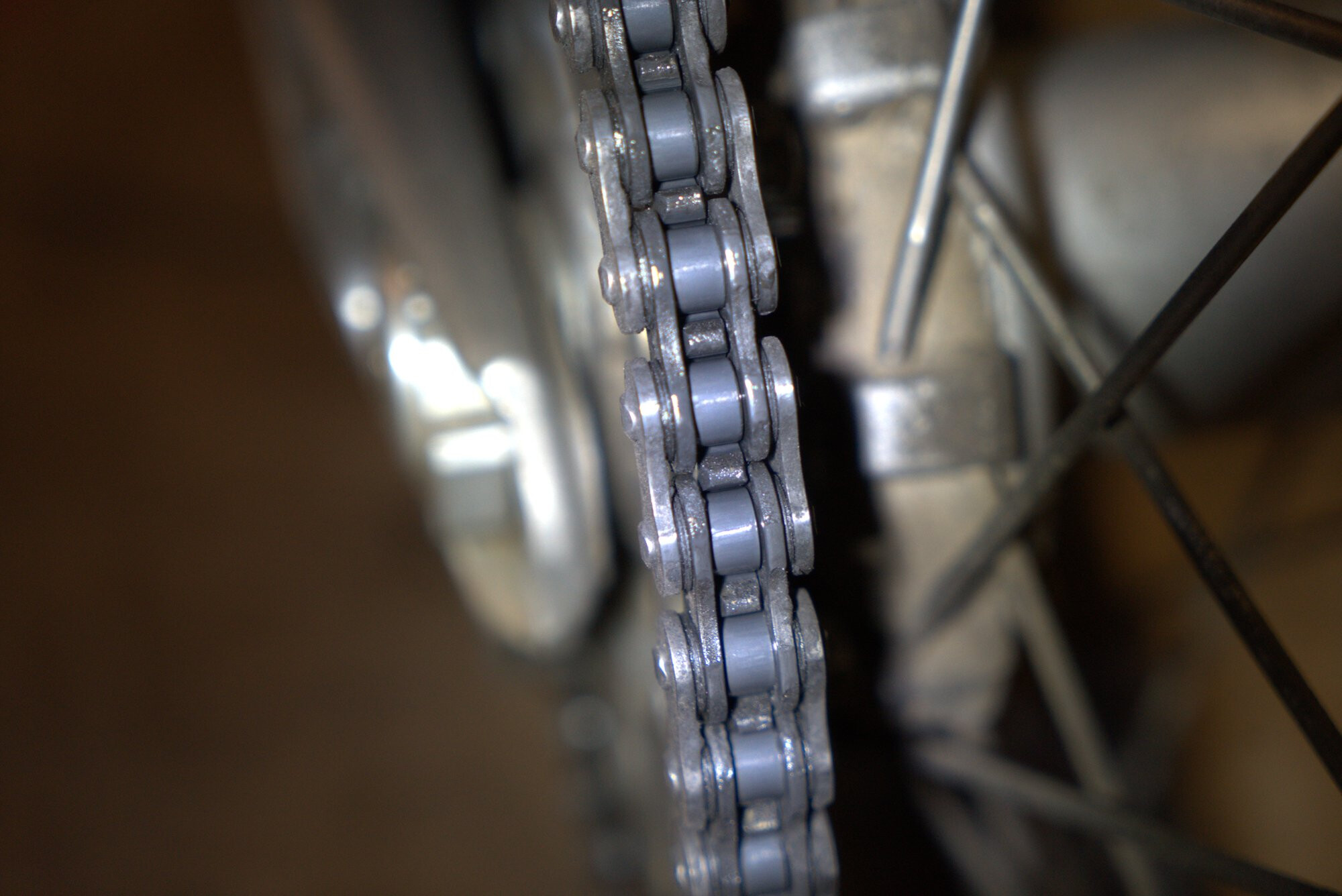
This is how it should look: rollers and plate edges evenly wetted, no crust, nothing dripping.
This is how it should look: rollers and plate edges evenly wetted, no crust, nothing dripping.
In rain and dust, the film wears off faster. In rough terrain, timing therefore matters more than quantity. Adding lubricant in the middle of the dust achieves nothing. What matters is applying it after the off-road section, before heading back onto the road at speed.

Off-road, every lubricant binds dust. Oil and sand form a paste on the rear sprocket and plates, and dirt determines wear.
Off-road, every lubricant binds dust. Oil and sand form a paste on the rear sprocket and plates, and dirt determines wear.
How do you lubricate a chain with chain spray?
Chain spray is applied with the engine off, ideally to a warm chain after a ride, aimed at the rollers and plate edges and thus at the seals. The film then needs time to set, around 20 minutes depending on the product; otherwise the chain flings it off while it is still liquid. The lubrication intervals in vehicle handbooks are usually between 300 and 800 km, plus after every ride in rain or off-road.
Chain spray is an aerosol of lubricant, solvent and propellant. After application the solvent evaporates, leaving a viscous film behind. Most products are tacky greases, often white, some with PTFE or molybdenum disulphide. There are also oil-based sprays, wax sprays, dry lubes with PTFE, special off-road sprays and biodegradable versions. What matters is approval for O-ring, X-ring and Z-ring chains, which is standard on branded products today. Comparison tests in the trade press, such as those by MOTORRAD together with KÜS, mainly assess lubricating performance, fling-off behaviour, dirt pick-up, corrosion protection and material compatibility.
In favour of chain spray are its low price, its availability at any accessory shop and its good corrosion protection, and no installation is needed. The difficulty lies in how it behaves over time. The spray film is a reserve that starts to break down as soon as it is applied: straight after spraying it is too thick and is partly flung off; shortly before the next application it is too thin. On top of that, there is a contradiction in the product itself: for the grease to stay on the chain at high speed it needs tackiness additives, and these are exactly what hold on to dust and sand. In our own long-term test, consumption and cost came to around 80 ml and €3.62 per 1,000 km. On a trip to the North Cape, there was no longer a load-bearing film after only about 100 km in the rain.
White chain spray, clear chain spray, PTFE and dry lube
White chain spray dries to a light-coloured film. The colour shows where lubricant has already been applied and makes it easier to spray evenly. It says nothing about lubricating performance. Clear sprays work on the same principle and are less conspicuous on the chain. PTFE, better known as Teflon, is a solid lubricant that is added to many sprays and reduces friction. Dry lube refers to dry lubricants that are barely tacky once they have set. They attract less dirt and hardly soil the rim, but last less long in the wet, do not creep well under the rollers and have to be applied more often. On dry roads they are a good choice; for rain and winter, a tacky spray or oil is better suited.
WD-40 on a motorcycle chain
Classic WD-40 is a penetrating oil and water displacer. It is no good as a chain lubricant because its thin film disappears quickly. It is often used to loosen dirt, but it also degreases in the process. The manufacturer confirmed to heise that the standard product leaches plasticisers out of seals and accelerates their ageing. In an immersion test by the US magazine Motorcyclist, on the other hand, O-rings showed no visible damage in the short term. For motorcycle chains, WD-40 has its own Specialist Motorbike range with chain cleaner, chain spray and chain wax, which is approved for O-rings, X-rings and Z-rings. These products should be distinguished from classic WD-40.
How do you oil a chain by hand?
When oiling by hand, chain oil, gear oil or chainsaw bar oil is applied with a brush or from a drip bottle, ideally to the inside of the lower run while turning the rear wheel with the engine off. The method is the oldest and is still perfectly usable. Brush systems such as the Kettenmax enclose the chain and clean and oil it in a single pass. Oil creeps under the rollers better than tacky grease, is easy to dose and is very cheap. The effort is the same as with chain spray, and if too much is used, oil is flung off. Engine oil is too thin and has no tackiness additives, and used oil contains wear particles. Neither belongs on a chain.
Which oil is suitable for a motorcycle chain and a chain oiler?
Well suited are chain oil approved by the oiler manufacturer and mineral chainsaw bar oil; gear oil is widely used. Engine oil, used oil, cooking oil and classic WD-40 do not belong on a chain. A chain oil has to do several things at once: adhere to the chain, creep under the rollers, flow evenly across the temperature range, not attack the seals and not gum up even after months of standing. Some of these requirements conflict. An oil that adheres well is used more sparingly and ends up on the rim less often, but it also holds more dirt on the chain. On the road, a tacky oil is the right choice. Off-road, however, fling-off can actually be desirable, because the oil that comes off takes dirt with it. There is therefore no single oil that is best for every riding profile.
The same oils are suitable for hand lubrication and for a chain oiler. With an oiler, the oil also has to be compatible with the reservoir, hose, valve and nozzle. Very sticky tacky oils and greases clog nozzles and bind a lot of dirt off-road. Chain oils are classified by ISO VG viscosity grades, with VG 68 to VG 220 being common. With gravity-fed and vacuum-operated oilers, the viscosity changes with temperature, and with it the delivery rate. Some manufacturers therefore offer separate oils for summer and winter.
| Oil | Suitability | Note |
|---|---|---|
| Chain oil approved by the oiler manufacturer | first choice | matched for adhesion, flow behaviour and system |
| Chainsaw bar oil, mineral | suitable | adheres well, is cheap and is recommended by the developers of several DIY oilers |
| Chainsaw bar oil, biodegradable (rapeseed-oil based) | with caution | biodegradable, can gum up after long periods of standing and clog lines, nozzles or chain links |
| Gear oil (e.g. SAE 80) | widely used | flows evenly; compatibility of the additives with seals is not properly documented |
| Bicycle chain oil | works | expensive in small containers |
| Engine oil | unsuitable | too thin, no tackiness additives, is flung off |
| Used oil | unsuitable | contains wear particles |
| Cooking or vegetable oil | unsuitable | gums up |
| WD-40 (standard product) | unsuitable | no load-bearing film; according to the manufacturer, leaches plasticisers out of seals |
For the MOFESSOR, we rule out biodegradable oils because they can gum up after longer periods of standing.
What types of automatic chain oiler are there?
There are three types: vacuum-operated oilers, mechanically or manually triggered oilers and electronically controlled oilers. All share the same basic design: an oil reservoir feeds a nozzle at the rear sprocket, the front sprocket or directly on the chain via a hose. Instead of a large quantity at longer intervals, a small amount of oil is continuously topped up while riding. This keeps the lubricant film at an almost constant level. Because the oil does not have to be designed for maximum adhesion, it binds less dirt and washes some of it back off the chain. The systems differ in how oil delivery is triggered and metered.

The drop falls from the nozzle onto the centre of the chain and spreads over the roller and plates. The oil has been made visible under UV light for the photo.
There are three types: vacuum-operated oilers, mechanically or manually triggered oilers and electronically controlled oilers. All share the same basic design: an oil reservoir feeds a nozzle at the rear sprocket, the front sprocket or directly on the chain via a hose. Instead of a large quantity at longer intervals, a small amount of oil is continuously topped up while riding. This keeps the lubricant film at an almost constant level. Because the oil does not have to be designed for maximum adhesion, it binds less dirt and washes some of it back off the chain. The systems differ in how oil delivery is triggered and metered.
The drop falls from the nozzle onto the centre of the chain and spreads over the roller and plates. The oil has been made visible under UV light for the photo.
The vacuum-operated oiler as the pioneer
The Scottoiler, developed by Scotsman Fraser Scott, came onto the market in 1984 and made automatic chain lubrication widely known. The classic system, available today as the vSystem, works purely mechanically: with the engine running, the vacuum in the intake tract lifts a diaphragm, and the oil flows to the nozzle by gravity. No electrics are needed. However, the principle has limitations that weigh more heavily on modern motorcycles. It needs a suitable vacuum port on the intake tract, which is not available on every fuel-injected engine. The flow rate depends directly on the oil viscosity and therefore on temperature. The manufacturer therefore offers oils for warm and cold seasons, and the flow rate has to be readjusted regularly. Scottoiler itself now also offers electronic systems.
Mechanically or manually triggered oilers
A second group also does without electrics. On the Tutoro, the motion of the bike opens a valve and the oil drips by gravity. On the Cobrra Nemo 2, the reservoir is pressurised by twisting it and then dispenses oil for a few minutes; on the Loobman, the rider triggers oil delivery by hand. These systems are simple and usually inexpensive. Their drawback is that dosing either depends on the rider or fluctuates with temperature and viscosity.
Electronically controlled oilers
Electronic systems meter the oil via a pump or valve and control delivery according to time, distance or speed. Depending on the system, distance is recorded via a speed sensor on the wheel, the speedometer signal, GPS or an acceleration sensor. Many systems have an adjustable base quantity and a button for increased dosing in rain or after off-road sections. With a defined delivery, the temperature dependence of oil viscosity plays a smaller role than with gravity and vacuum systems. The downsides are the more involved installation with a switched 12 V supply and the higher price.
Our MOFESSOR belongs to this group. It works with an electronically controlled metering valve whose opening time is adjusted based on a temperature measurement. This keeps the oil quantity delivered the same at any temperature, so there is no need for separate summer and winter oils. On top of that, there are ten flow rate settings and a rain switch for an increased quantity while riding. Depending on the version, the oil reservoir holds 60 or 120 ml, enough for at least 5,000 or 10,000 km respectively. It is activated via a switched 12 V supply. Installation positions for the reservoir, valve and nozzle are documented for more than 160 motorcycle models.
What speaks against a chain oiler
A few drawbacks come up again and again in user forums. Installation takes time: the reservoir, hose and nozzle have to be routed so that they follow the full suspension travel without getting into the path of the slapping chain. Electronic systems also need a power connection. In our own long-term test, this took 120 minutes on a vehicle without a documented installation solution. The dosage has to be set and is not correct for every motorcycle out of the box. If it is too high, oil ends up on the rim, the number plate and, in the worst case, the tyre sidewall. That is a safety issue and, in forums, one of the most frequently cited reasons for removing an oiler again. Too much oil also drips off when the bike is parked and binds additional dirt. Finally, a chain oiler costs many times as much as a can of spray to buy.
Chain oilers: market overview
| Manufacturer | System | Principle | Oil delivery trigger |
|---|---|---|---|
| Scottoiler (UK) | vSystem | vacuum, gravity | vacuum in the intake tract |
| Scottoiler (UK) | eSystem, xSystem | electronic | speed-dependent, xSystem via app |
| Tutoro (UK) | Tutoro | mechanical, gravity | motion of the bike |
| Cobrra | Nemo 2 | mechanical, pressurised | manually by twisting the reservoir |
| Loobman | Loobman | mechanical, gravity | manually at the push of a button |
| CLS (DE) | CLS-EVO | electronic | distance-dependent, handlebar control unit |
| McCoi (DE) | McCoi | electronic | distance-dependent |
| Rehoiler (DE) | Rehoiler | electronic, DIY project | distance-dependent via speed sensor on the wheel |
| BEROTEC (DE) | MOFESSOR | electronically controlled metering valve, temperature-compensated | ten flow rate settings, rain switch |
Prices range roughly from under €50 for simple mechanical drip feeders to over €400 for electronic systems with a handlebar control unit.
What do measurements show about continuous and interval lubrication?
Controlled comparisons are rare. One of the few peer-reviewed studies is by Palazzetti and Yan (University of Strathclyde, Industrial Lubrication and Tribology, 2016). Three chain and sprocket kits with Tsubaki O-ring chains (525 pitch) each covered 9,650 km on the road, with the same rider on the same commuting route. To ensure that weather and salt affected all kits equally, they were swapped around every 2,400 km or so. One kit was left unlubricated, one received PTFE spray every 480 km, and the third received one drop of light mineral oil per minute from an automatic chain oiler (Scottoiler eSystem). Efficiency, chain temperature and vibration were then measured on a test rig, although only at a low load of 10 Nm.
| Measured variable (test rig) | unlubricated | Spray at intervals | Continuous oiling |
|---|---|---|---|
| Efficiency at 1,250 rpm | 0.686 | 0.676 | 0.719 |
| Efficiency at 1,400 rpm | 0.670 | 0.683 | 0.724 |
| Efficiency at 1,700 rpm | 0.695 | 0.702 | 0.729 |
| Efficiency at 2,400 rpm | 0.743 | 0.746 | 0.734 |
| Chain temperature at 1,250 rpm | 36.2 °C | 29.1 °C | 21.1 °C |
| Chain temperature at 1,700 rpm | 38.2 °C | 30.5 °C | 24.7 °C |
| Chain temperature at 2,400 rpm | 40.9 °C | 35.7 °C | 28.2 °C |
| Vibration (RMS) at 1,400 rpm | 0.96 | 0.87 | 0.50 |
| Vibration (RMS) at 2,400 rpm | 2.03 | 1.43 | 1.35 |
For temperature and vibration, continuous oiling comes out ahead at every speed. According to the authors, the oil dissipated around 80% more heat on average than the spray. In terms of efficiency, continuous oiling leads up to 1,700 rpm. Across all measurements, the authors put its advantage over the spray at 3.6%. At 2,400 rpm it was slightly behind, which the authors attribute to measurement scatter caused by vibration. The value at 1,250 rpm stands out: there the sprayed chain was actually less efficient than the unlubricated one. The study offers no explanation for this. With three chain and sprocket kits and a low test load, the study is small, but the differences in temperature and vibration are nonetheless clear. The authors link this to wear: a cooler chain wears less, and lower vibration means softer impacts at the tooth engagement.
We ran our own comparison with two brand-new FANTIC Caballero 500 Rally bikes side by side over 15,836 km, one with Kettenspray S100 chain spray, the other with the MOFESSOR. Just under a quarter of the distance was off-road or in the rain. At the end, chain elongation was 0.22% versus 0.15% and lateral slack over 20 links was 54.1 mm versus 45.1 mm, in each case in favour of the chain oiler. On dismantling, the grease behind the O-rings of the spray chain had turned crusty, while in the oiler chain it was still present as a paste. Working time was 305 versus 248 minutes including installation, and consumables cost €3.62 versus €0.39 per 1,000 km. Rollers and front sprocket, on the other hand, wore more on the oiler bike, which was down to the loose front sprocket nut in the first half of the test. After the front sprocket was replaced, the rollers of both chains wore almost equally (0.13 and 0.12 mm), so the difference arose in the first half of the test. That elongation and roller wear can respond differently to the lubrication method is shown by a test rig study from the University of Leeds (Lee and Priest, 2004): there, drip-fed light oil gave the best wear protection between rollers and pins, while chain sprays protected the contact between roller and sprocket better. At the end of the test, both chain and sprocket kits were worn, because the high proportion of dirt largely masked the differences between the lubrication methods. Caveats: one vehicle type, one chain per method, carried out by a chain oiler manufacturer. All measurement series are in the article Chain oiler vs chain spray: long-term test.
Kettenöler vs. Kettenspray im Praxistest - FANTIC Caballero 500 Rally I MOFESSOR Vergleich
1
Kettenöler vs. Kettenspray im Praxistest - FANTIC Caballero 500 Rally I MOFESSOR Vergleich
2
Kettenöler vs. Kettenspray - Zwischenstand 1500 km - FANTIC Caballero I MOFESSOR
3
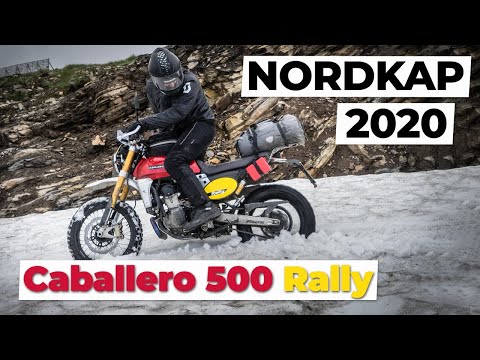
Caballero 500 Rally am Nordkap - 7000KM in 8 Tagen | Kettenöler vs. Kettenspray im Praxistest
4
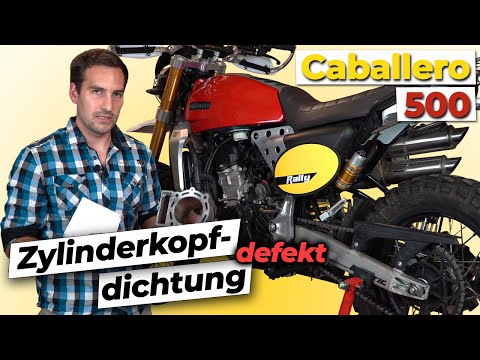
FANTIC Caballero 500 - Defekte Zylinderkopfdichtung und Inspektion I Kettenöler vs. Kettenspray
5
FANTIC Caballero - Kaufempfehlung? I Rückblick auf 23.000km Caballero 500 Rally
6
FANTIC Caballero | Fragen, Antworten, Fazit | Kettenöler vs. Kettenspray Abschlussbericht
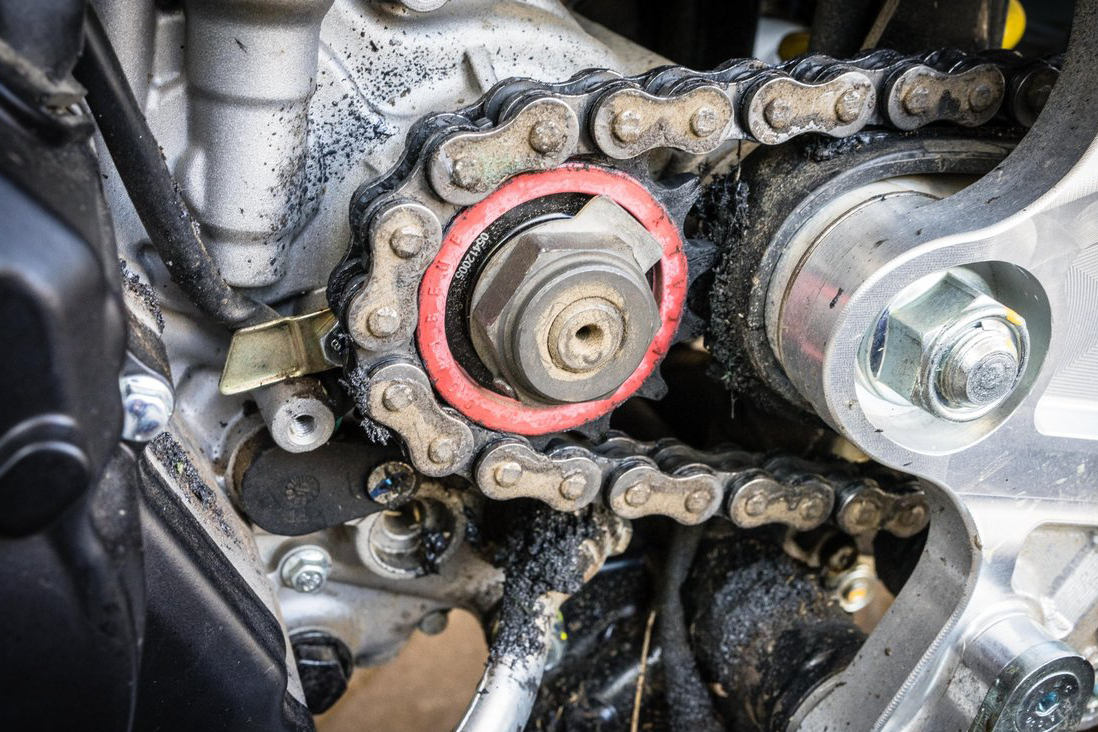
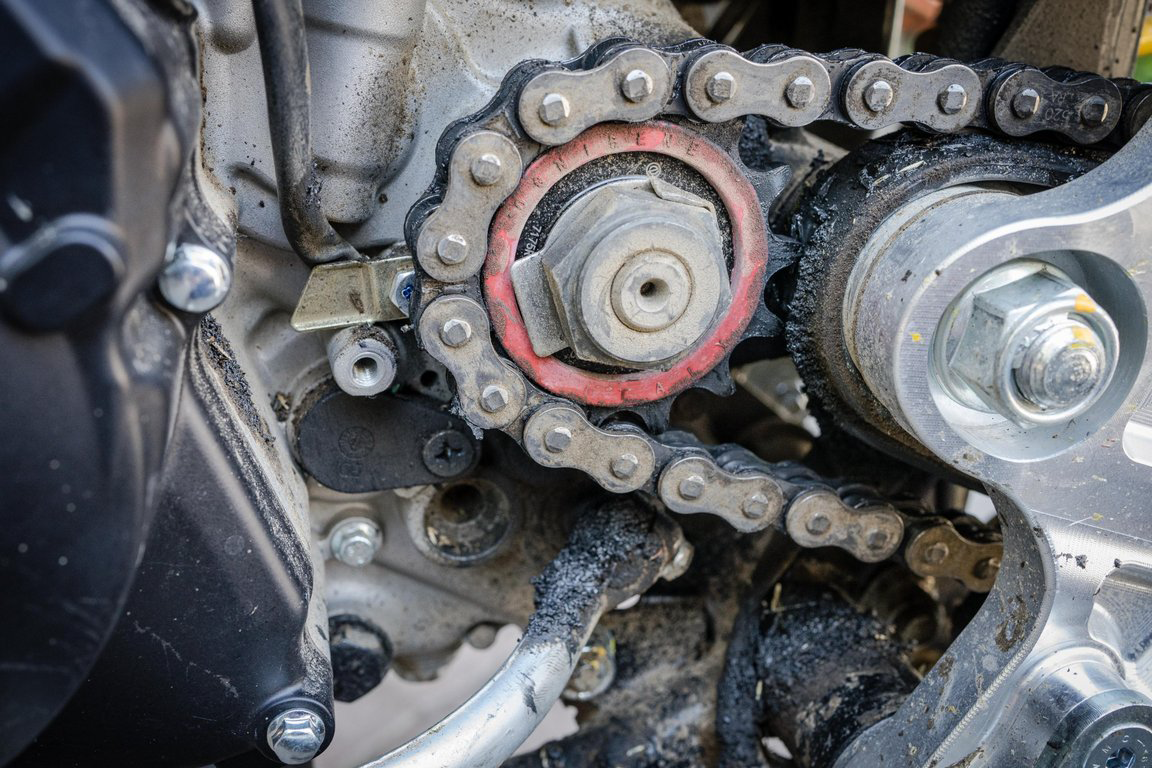
Direct comparison after 1,445 km: front sprocket area of the spray bike (left) and the chain oiler bike (right).
Direct comparison after 1,445 km: front sprocket area of the spray bike (top) and the chain oiler bike (bottom).
Is hot waxing any good for a motorcycle chain? (niche)
Hot waxing is of little use for motorcycle chains, because on sealed chains the wax never reaches the joint and the effort involved is considerable. In cycling, waxing the chain is regarded as one of the most efficient lubrication methods. Measurements by Friction Facts for VeloNews put paraffin wax at the top of the table there, and the method has a loyal following. The chain is removed, completely degreased and soaked in molten wax, which solidifies in the joints as it cools and attracts very little dirt.
On a sealed chain the joint is closed off, so the wax cannot reach the point where it does its job on a bicycle. Thorough degreasing with solvents also puts strain on the seals and can attack the factory grease. On top of that comes the considerable effort of removing and re-riveting a motorcycle chain, and the wax film's poor resistance to wet conditions. In theory the method remains an option for non-sealed chains on classic bikes and small-capacity motorcycles. Wax from an aerosol can is a different matter: it belongs to the chain sprays.
Other niche methods
Some methods keep cropping up in forums and workshops but are fringe practices today:
- Soaking the chain in hot grease or oil (“boiling” it): common in the past with non-sealed chains, harmful to sealed chains
- Chain grease applied with a brush: good corrosion protection, but attracts a lot of dirt
- Graphite or molybdenum disulphide as a dry powder: clean, but with no meaningful replenishment at the tooth engagement
- Silicone spray: little load-bearing capacity, more a care product than a lubricant
- Vegetable oil: biodegradable, but turns gummy when the bike stands for long periods
- Home-made drip feeders, for instance made from an IV drip set: they work, but metering and durability depend on the builder
What happens if you never lubricate the chain?
Without lubrication, the rollers and tooth engagement run dry, the seals age faster and the chain wears out considerably sooner, even though it is sealed. The non-lubricators' argument sounds plausible at first: the joint of a sealed chain is lubricated for life, a dry chain does not pick up dirt, and some riders report decent mileages with cleaning alone. There is some truth to this, since even the best lubricant applied from outside cannot reach the sealed joint.
The two external friction points and the seals, however, are left unprotected. Side plates and rollers rust, and as soon as a seal fails, the joint is lost as well. In the study by Palazzetti and Yan, the unlubricated chain ran the hottest and with the highest vibration levels. D.I.D and RK specify regular cleaning and lubrication. Whatever is saved on lubricant is lost again through an earlier chain and sprocket kit replacement. Pausing lubrication only makes sense while riding through dust or mud; afterwards the chain is cleaned and lubricated.
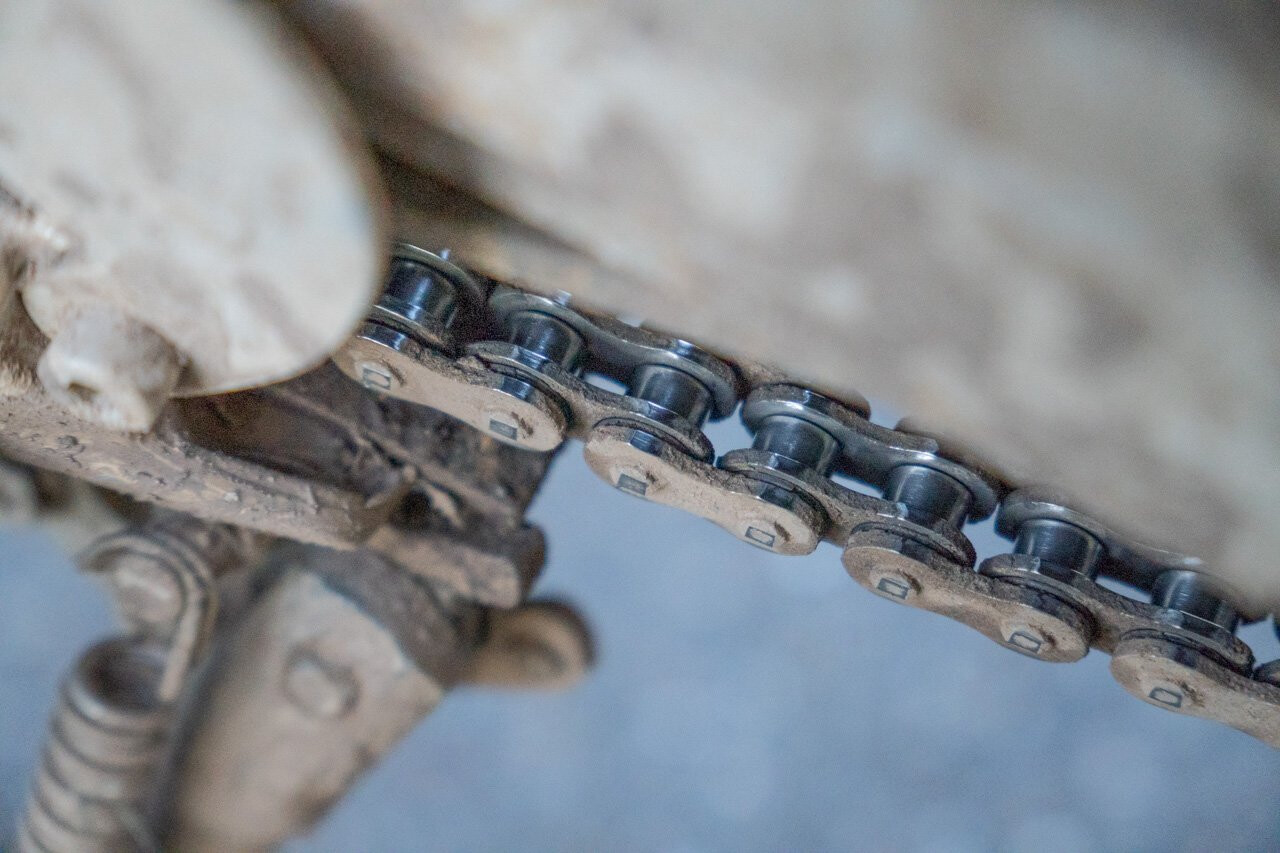
Unlubricated after an off-road ride: the rollers are bare and dry, and dust has settled on the side plates.
Without lubrication, the rollers and tooth engagement run dry, the seals age faster and the chain wears out considerably sooner, even though it is sealed. The non-lubricators' argument sounds plausible at first: the joint of a sealed chain is lubricated for life, a dry chain does not pick up dirt, and some riders report decent mileages with cleaning alone. There is some truth to this, since even the best lubricant applied from outside cannot reach the sealed joint.
The two external friction points and the seals, however, are left unprotected. Side plates and rollers rust, and as soon as a seal fails, the joint is lost as well. In the study by Palazzetti and Yan, the unlubricated chain ran the hottest and with the highest vibration levels. D.I.D and RK specify regular cleaning and lubrication. Whatever is saved on lubricant is lost again through an earlier chain and sprocket kit replacement. Pausing lubrication only makes sense while riding through dust or mud; afterwards the chain is cleaned and lubricated.
Unlubricated after an off-road ride: the rollers are bare and dry, and dust has settled on the side plates.
How environmentally friendly are the methods?
Every lubrication method releases lubricant into the environment, whether oil, grease or wax. Comparing chain spray and chain oiler, the quantity is considerably smaller with the oiler; with spray there is also overspray, propellant and the can itself. A lubricated chain always flings off some of its lubricant in use, with a chain oiler just as with spray. Chain spray tests therefore check fling-off behaviour as standard. When spraying, some of it misses the chain as overspray and lands on the swingarm, tyre and ground. For the Kettenspray S100 we used in the long-term test, the safety data sheet lists, among others, the hazard statements “Extremely flammable aerosol” and “Toxic to aquatic life with long lasting effects”. Solvents and propellant account for at least 60% of the can's contents. Empty cans go into recycling collection; cans with contents remaining go to hazardous waste collection.
In our long-term test over 15,836 km, around 1,300 ml of chain spray was used against 204 ml of chain oil, roughly six times as much. How much of it actually ends up in the environment in each case has not been measured. PTFE, found in many chain sprays, is extremely persistent and practically does not break down in the environment. It belongs to the PFAS group of substances, which are also called forever chemicals because of this persistence. Whether the plastic itself is harmful is disputed. The EU is working on a PFAS restriction that may also cover fluoropolymers such as PTFE; no decision has been made yet. Biodegradable chain oils and sprays are available, but they have lower oxidation stability and can turn gummy when the bike stands for long periods. There is no specific regulation for motorcycle chain lubricants. Anyone wanting to reduce the environmental impact will get furthest by reducing the quantity.
How do you clean a motorcycle chain?
A motorcycle chain is cleaned with a chain cleaner approved for O-rings, X-rings and Z-rings and a soft brush. It is then dried and lubricated. Clean it whenever dirt, sand or old lubricant has built up on the chain, and in any case before re-lubricating a visibly dirty chain. For sealed chains, D.I.D recommends cleaning and lubricating roughly every 500 km and after every ride in the rain. With chain spray, dirt builds up faster because the tacky grease binds it. With a chain oiler, wiping is usually enough, as the thin oil flings off some of the dirt by itself.
The procedure: park the motorcycle securely, switch off the engine, spray on chain cleaner and leave it to act briefly. Then work over the rollers, side plates and gaps with a soft brush, such as a three-sided chain brush. Wipe off the loosened dirt with a cloth or rinse it off at low water pressure, let the chain dry and then lubricate it. Go easy on the seals: use a soft brush rather than a wire brush or hard bristles, and keep the water jet at a distance. A chain does not have to be scrubbed spotless. Using aggressive products and lots of pressure at every clean does more harm to the seals than a bit of remaining dirt does to the chain.
Recommendations on cleaning agents differ. The chain manufacturers are cautious: for sealed chains, RK advises against paraffin (kerosene), white spirit, diesel, brake cleaner and engine oil, and D.I.D against volatile solvents such as petrol.
| Agent | Suitability | Note |
|---|---|---|
| Chain cleaner approved for O-rings, X-rings and Z-rings | recommended | developed for sealed chains; approval stated on the can |
| Paraffin (kerosene) | common, use with caution | dissolves grease and dirt well and is often recommended by workshops and guides. RK advises against it for sealed chains. Apply sparingly, do not soak the chain, then wipe off and lubricate. |
| Diesel | not recommended | leaves an oily residue; RK advises against it |
| Petrol | unsuitable | flammable; D.I.D advises against volatile solvents |
| Brake cleaner | not recommended | aggressive and chlorinated products attack the seals; RK advises against it. If you use it anyway, choose an acetone-free product and only let it act briefly. |
| WD-40 (standard product) | limited | loosens dirt, but also degreases and, according to the manufacturer, leaches plasticisers out of seals. WD-40 offers dedicated chain cleaners for chains. |
| Water with a mild cleaner | for heavy dirt | then let the chain dry and lubricate it immediately |
| Pressure washer | only from a distance | at close range, the jet forces water past the seals |
| Wire brush, hard bristles | unsuitable | damage the seals; RK advises against them |
How do you look after the chain without a centre stand?
Many motorcycles only have a side stand. The most convenient way to work is with a rear paddock stand, which lets the wheel turn freely. Without a stand, the side stand method helps: put the motorcycle on its side stand, shift into neutral and switch off the engine. Clean or lubricate the accessible section of chain, then push the motorcycle forward a little and work on the next section until the whole chain has been treated. A piece of cardboard in front of the rim catches overspray. For adjusting the chain, the side stand is sufficient as long as the owner's manual specifies measuring in that position. With a chain oiler, lubricating without a stand is no longer necessary at all.
One rule always applies: never lubricate or clean with the engine running and a gear engaged, not even to let the rear wheel turn conveniently. Fingers, cloths or brushes are pulled in between chain and rear sprocket in a fraction of a second, and the injuries are severe.
How long does a motorcycle chain last?
A sealed, well-maintained chain lasts around 30,000 to 40,000 km on the road; a neglected one often less than 10,000 km. There is no universally valid figure: maintenance, use and riding style can shift mileage by a factor of several, and published figures come mostly from manufacturer's figures, the trade press and individual reports.
| Chain and use | Mileage | Source | Type of figure |
|---|---|---|---|
| Sealed, well maintained, road | up to around 40,000 km | MOTORRAD | trade press guideline |
| Sealed, neglected | under 10,000 km | MOTORRAD | trade press guideline |
| Sealed, general guideline | around 20,000 miles (approx. 32,000 km) | RK | manufacturer's figure |
| Non-sealed | around 3,000 miles (approx. 4,800 km) | RK | manufacturer's figure |
| Sealed, with chain oiler, road | two to three times the mileage compared with chain spray, e.g. BMW S 1000 RR with 55,000 km | BEROTEC | experience-based value |
| Sealed, with chain oiler, road | 30,000 to 60,000 km in individual reports | user forums, supplier McCoi | individual reports |
| High proportion of dust and mud | roughly one tenth of road mileage | BEROTEC | estimate |
In terms of cost, the chain and sprocket kit is the biggest item. A single replacement saved covers the purchase of a chain oiler. However, this calculation only works out where the oiler actually adds mileage, i.e. mainly on the road.
What is proven and what is not
Many figures circulate about chain lubrication, and not all of them are measured. We therefore distinguish between what is proven, experience-based values, and what cannot be proven.
Proven by measurement or specialist source:
- Continuous oiling, compared with intermittent spray lubrication, significantly reduces chain temperature and vibration and improves efficiency in the low and mid rpm range (Palazzetti and Yan 2016, peer-reviewed study).
- External lubrication does not reach the sealed joint; it acts on the rollers, tooth engagement, seals and corrosion protection (chain manufacturers, trade press).
- A chain marketed as maintenance-free failed to prove this in a real-world test, and the manufacturer withdrew the claim (BMW M Endurance, RevZilla).
- In our own side-by-side comparison, the chain on the chain oiler showed less elongation, less lateral slack and retained its grease fill (BEROTEC long-term test, one chain per method).
Experience-based values, labelled as such:
- On the road, in our experience, continuously lubricated chains achieve two to three times the mileage of spray-lubricated chains. This is based on many years of using chain oilers on our own vehicles and on customer feedback. The reference from our own fleet is a BMW S 1000 RR whose chain and sprocket kit was still in good order after 55,000 km with an oiler.
- With a chain oiler, an intact chain generally does not need re-adjusting between two tyre changes.
- A good aluminium rear sprocket usually lasts as long as the chain and sprocket kit, because the front sprocket wears out first.
- In the rain, a sprayed-on film is no longer load-bearing after about 100 km.
- In genuine off-road use, chain life drops by roughly a factor of ten.
Unproven:
- There is no publicly available controlled study with several vehicles per method that provides a figure for the longer mileage. Claims such as “up to seven times” are based on user reports.
- How much lubricant actually ends up in the environment with each method.
- Manufacturer-independent mileage figures for steel, aluminium or hybrid rear sprockets.
Which chain lubrication suits which riding profile?
| Riding profile | Obvious solution | Reasoning |
|---|---|---|
| Occasional riders, a few thousand kilometres a year | Chain spray or oil by hand | intervals are easy to keep to; an oiler only pays for itself over many years |
| Commuters and everyday riders, including in the rain | Chain oiler | frequent rides, wet and salt; the film is constantly renewed |
| High-mileage riders and tourers | Chain oiler | longer mileage, less work, no can in the luggage |
| Touring with some off-road riding | Chain oiler with rain mode | after the off-road section there is oil on the chain again without stopping |
| Hard enduro, sand and mud | Dry lube or off-road spray used sparingly; clean after the ride | dirt determines wear; an oiler is optional |
| Winter riders | Chain oiler or tacky chain spray | corrosion protection takes priority; rinse off salt after every ride |
| Race track | Chain spray applied specifically before the session, wipe off excess | a clean chain matters more than quantity; don't risk oil on the tyre sidewall |
Which chain lubrication suits which motorcycle?
On adventure bikes such as the BMW F 900 GS, Yamaha Ténéré 700, Honda Africa Twin or KTM 890 Adventure, all the arguments for a chain oiler come together: long stages, changing surfaces, rain and little opportunity to spray on the road. Tourers and naked bikes that cover a lot of miles benefit for the same reasons. On supersports bikes there is nothing against an oiler, but the metering deserves particular care because of the lean angles. Light enduros and competition enduros with a high off-road share get on well with spray or dry lube and frequent cleaning; an oiler is mainly worthwhile on longer road link sections. On small-capacity motorcycles with simple, often non-sealed chains, oiling by hand is the most economical option, but it means lubricating more often. Classic bikes with a non-sealed chain need regular oiling. Here it is worth checking whether a sealed chain is available in the right pitch.
Enclosed chain case, toothed belt or shaft drive: can you do without chain care?
Anyone who wants to do without chain care entirely ends up with a different drive. The fully enclosed chain case is familiar from MZ, for example. It protects the chain from dirt and water and extends maintenance intervals. On current motorcycles it has practically disappeared, because it costs weight, space and effort when changing a wheel.
The toothed belt, widespread on Harley-Davidson and formerly used on the BMW F 800 S, F 800 ST and F 650 CS, needs no lubrication and runs quietly and cleanly. It must not be lubricated either, as it would otherwise attract dirt. Compared with a chain, a belt is wider, is sensitive to stones and incorrect tension, and is more expensive to replace. Depending on the manufacturer, it lasts several tens of thousands of kilometres, provided it is regularly inspected visually and its tension checked.
The shaft drive on models from BMW, Moto Guzzi, Honda, Yamaha or Triumph is the lowest-maintenance drive. Maintenance essentially means the oil in the final drive, plus the joints and bearings as wear parts. Against this are higher weight, higher cost, a slightly greater power loss and no easy way of changing the gearing.
Myths and half-truths about the motorcycle chain
| Claim | Verdict | Explanation |
|---|---|---|
| Chains stretch over time. | false | Elongation is caused by wear between pin and bush. The side plates do not stretch. |
| O-ring chains don't need lubricating. | false | The factory grease only lubricates the joint. Rollers, tooth engagement and seals need external lubrication. |
| Chains sold as maintenance-free don't need any lubricant. | false | BMW, which announced the M Endurance chain as maintenance-free in 2020, later only advertised it as having reduced maintenance requirements. A teardown after real-world use revealed damaged seals and wear on the pins. |
| You can tell wear from the slack. | false | Slack only shows the tension. Wear is shown by elongation. |
| If the elongation is still within limits, the chain is fine. | partly true | Rollers and teeth wear independently and can finish off a chain and sprocket kit before the elongation limit is reached. Tooth profile and the pull-off test are part of the check. |
| The more lubricant, the better. | false | Excess is flung off, attracts dirt and can get onto the tyre sidewall. |
| The chain must be lubricated after every ride. | partly true | After rain and off-road riding, yes; otherwise the intervals in the owner's manual are sufficient. |
| You can ride off immediately after spraying. | false | The solvent has to evaporate first, otherwise the film is flung off. |
| It makes no difference whether the chain is lubricated cold or warm. | partly true | On a warm chain the lubricant spreads better and the solvent evaporates faster. |
| WD-40 is a chain lubricant. | false | The standard product is a penetrating oil and water displacer with a thin film that evaporates quickly. The manufacturer offers dedicated products for chains. |
| WD-40 destroys O-rings instantly. | disputed | In Ari Henning's (Motorcyclist) immersion test, O-rings showed no visible damage in the short term. WD-40 confirmed to heise that the standard product leaches plasticisers out of seals and accelerates their ageing. |
| Brake cleaner is suitable for cleaning chains. | partly true | Aggressive and chlorinated cleaners attack the seals. Dedicated chain cleaners are safer. |
| A pressure washer does the chain no harm. | false | At close range, the jet forces water and dirt past the seals and washes out grease. |
| Engine oil or used oil is just as good as chain oil. | false | Engine oil is too thin and has no tackiness additives; used oil contains wear particles. |
| Off-road, it's best not to lubricate at all. | partly true | In the middle of the dust, extra lubricant achieves little. After the off-road section, the chain needs a film again. |
| Chain oilers make a mess of the rear tyre. | partly true | If the flow rate is set too high, yes. Set correctly, the oil stays on the chain. |
| Chain oilers don't work on fuel-injected bikes. | false | That only applies to vacuum-operated systems. Electronic oilers work independently of the intake tract. |
| Chain oilers are only for adventure bikes. | false | They work on any chain-driven motorcycle. High-mileage riders benefit most. |
| A chain oiler extends chain life sevenfold. | unproven | One supplier's claim is based on user reports. Our experience-based value on the road is two to three times. |
| Chain oil is more harmful to the environment than chain spray. | false | Every chain lubricant ends up in the environment. With spray there is also overspray, propellant and the can, and in our own long-term test consumption was roughly six times higher. |
| Biodegradable oil is unproblematic in an oiler. | open | Rapeseed-based oils can turn gummy when the bike stands for long periods and clog lines or nozzles. Check the manufacturer's approval. |
| A new chain is enough; the sprockets are still good. | false | Sprockets and chain wear together. A new chain on old sprockets wears out quickly. |
| A tight chain won't jump off. | false | An over-tight chain puts strain on the bearings and gearbox output shaft and wears faster. |
| As long as the adjuster still has travel left, the chain is fine. | false | The wear limit is usually reached long before the end of the adjustment range. |
| Gold chains last longer. | false | The colour comes from a coating for corrosion protection and looks. Strength is determined by the steel and the hardening. |
| Sealed chains are always the better choice. | partly true | On the road, yes. In motocross, non-sealed chains are often used because of their lower friction. |
| Aluminium rear sprockets only last a few thousand kilometres. | false | They wear faster than steel. But because the front sprocket wears out first, in our experience a good hard-anodised sprocket usually lasts as long as the chain and sprocket kit. |
| Front sprocket size has no effect on wear. | false | Small front sprockets increase the articulation angle and the load per tooth, and accelerate wear. |
| A clip link is as good as a rivet link. | partly true | Common on small bikes. On powerful road bikes a rivet link is standard; what counts is the specification of the chain and vehicle manufacturer. |
| Hot waxing, as on a bicycle, is the best lubrication. | partly true | Very efficient on a bicycle. On sealed chains the wax does not reach the joint. |
| Boiling the chain extends its life. | false | On sealed chains, heat and solvents damage the seals. |
| Toothed belts and shaft drives are maintenance-free. | false | Both require less maintenance. Belts need inspection and tensioning, shaft drives need oil changes. |
| Heavy motorcycles need thicker chain oil. | unproven | Viscosity depends on temperature and the delivery system, not on the vehicle's weight. |
Frequently asked questions about chain lubrication
How often should I lubricate my motorcycle chain?
With chain spray or oil by hand, at the interval given in the owner's manual, usually every 300 to 800 km, and additionally after every ride in the rain or off-road. A chain oiler continuously re-lubricates while you ride.
How can I tell if my chain is properly lubricated?
With the engine off, run a finger over the rollers: it should feel oily, but nothing should stick to your fingertip. If there is lubricant on the rim after a ride, it was too much. A dull, greyish chain with surface rust is getting too little.
Is a chain oiler better than chain spray?
For high-mileage road riders, the chain oiler, because it maintains the lubricant film, uses less and saves work. Occasional riders get away more cheaply with chain spray.
Is a chain oiler worth it?
Those who benefit most ride many kilometres, mainly on the road, ride in all weathers or go on long tours: the chain lasts longer, lubricating by hand is no longer necessary, and the chain needs adjusting less often. If you only ride a few thousand kilometres a year in dry weather, chain spray is the cheaper option.
Which is better: chain grease, chain spray or oil?
Chain spray is usually a tacky grease with a solvent. It adheres for a long time and protects well against corrosion, but attracts dirt. Oil creeps better under the rollers and attracts less dirt, but is flung off and therefore has to be applied in small quantities and more often, most easily with a chain oiler. For low-mileage riders spray is more practical; for high-mileage riders, oil.
Do I need to re-lubricate the chain after rain or after washing the bike?
Yes. Water displaces the lubricant film; D.I.D recommends cleaning and lubricating after every ride in the rain. After washing the motorcycle, let the chain dry and then lubricate it. A chain oiler with rain mode increases the quantity while you are still riding.
Can I use bicycle chain spray on a motorcycle chain?
Only if it is expressly approved for O-ring, X-ring and Z-ring chains. Many bicycle lubricants are designed for penetration and are quickly flung off at the speeds of a motorcycle chain. Conversely, motorcycle chain spray can also be used on a bicycle.
Does a new chain need cleaning before fitting?
No. The grease on a new chain protects against corrosion and serves as the initial lubrication. The chain is fitted as it is and then lubricated at the normal interval.
Does a chain advertised as maintenance-free, such as the BMW M Endurance, need lubricating?
Yes. BMW now only advertises the chain as having reduced maintenance requirements. In a real-world test by RevZilla, it was worn out after 12,000 miles without any care, and several seals were damaged.
Frequently asked questions about wear, tensioning and costs
When is a motorcycle chain worn out?
When elongation reaches the manufacturer's limit, which according to D.I.D is 1% for sealed chains. Rollers and teeth may, however, be finished before that. Other signs are hooked teeth, stiff links and a chain adjuster at the end of its adjustment range.
Do I need to replace the front and rear sprockets together with the chain?
Yes. Chain and sprockets wear together; a new chain on old sprockets will not last long.
How much slack does a motorcycle chain need?
The specified value is given in the owner's manual or on a sticker on the swingarm. Road bikes are usually between 20 and 40 mm, enduros considerably more. It is measured in the middle of the lower run at the tightest point.
How often should I adjust my chain?
Check it at every lubrication or roughly every 500 to 1,000 km, and adjust it as soon as the slack is outside the specification. With a chain oiler, the chain elongates more slowly. In our experience, an intact chain then generally does not need re-adjusting between two tyre changes.
How much does a new chain and sprocket kit cost, and how much does chain adjustment cost?
For mid-range bikes, the parts cost around €80 to €170; with fitting by a workshop, €200 or more is quickly reached. Workshops usually charge adjustment as a minor job based on time.
Clip link or rivet link?
The rivet link is the more durable connection and is standard on powerful road bikes. Clip links are common on smaller motorcycles and off-road, because they can be opened without a riveting tool. What counts is the specification of the chain and vehicle manufacturer.
Is surface rust on the chain a problem?
Light surface rust on the side plates after rain or a period of standing can be wiped off and is harmless if the chain is lubricated afterwards. Reddish powder that emerges at individual joints and comes back after cleaning, on the other hand, is fretting corrosion. In that case the seal has failed, the joint is running dry and the chain and sprocket kit needs replacing.
Does a chain oiler damage the tyre?
Only if the flow rate is set too high. If there is oil on the rim after a ride, the quantity needs to be reduced.
Does an X-ring chain last longer than an O-ring chain?
Generally yes, because the X-shaped seals produce less friction and seal better. Without external lubrication, however, both lose their advantage.
Sources
- Palazzetti, R.; Yan, X.-T. (2016): Study on lubrication effect on motorbike chain transmissions. Industrial Lubrication and Tribology 68(5), pp. 561–568, DOI 10.1108/ILT-10-2015-0142 (full text, author's manuscript)
- Lee, P. M.; Priest, M. (2004): An innovation integrated approach to testing motorcycle drive chain lubricants. In: Transient Processes in Tribology, Proc. 30th Leeds-Lyon Symposium on Tribology, Tribology and Interface Engineering Series 43, Elsevier, pp. 291–298 (White Rose Research Online)
- D.I.D: Chain Maintenance (wear limits, care)
- RK Excel America: Maintenance (mileages, cleaning)
- MOTORRAD: Richtige Kettenpflege (in German)
- KÜS: Motorrad-Kettensprays im Vergleich (in German)
- VeloNews: 30 chain lubes lab tested for efficiency (Friction Facts)
- RevZilla / Common Tread: BMW's maintenance-free M Endurance chain put to the test
- heise autos: Schmierung der Motorradkette: ölen statt fetten (in German)
- Scottoiler: company history
- Scottoiler: system overview
- WD-40: Motorradkette schmieren (Specialist Motorbike range, O-ring/X-ring/Z-ring approval) (in German)
- Tsubaki: Sprocket Catalog, Troubleshooting section (brown discolouration of the joints due to inadequate lubrication)
- Wippermann: chain technology FAQ (fretting corrosion in the joints)
- IHK Braunschweig: Die PFAS-Beschränkung im Detail (status of the EU restriction, fluoropolymers) (in German)
- Dr. O.K. Wack Chemie: safety data sheet S100 Weißes Kettenspray, version 8.2 dated 15/12/2022 (hazard statements, composition) (in German)
- BEROTEC: Chain oiler vs chain spray: long-term test, 15,836 km, 2020–2021


