
Chain oiler vs chain spray, long-term test – 15,836 km, two motorcycles, every measurement
Two identical FANTIC Caballero 500 Rally, both factory-new, ridden 15,836 km side by side: one lubricated by hand with S100 chain spray, the other by the automatic MOFESSOR chain oiler. The outcome up front: less working time, one sixth of the lubricant consumption and lower chain elongation on the chain oiler side, with a wear pattern that looks contradictory in two places at first.
How was the test run?
Two factory-new FANTIC Caballero 500 Rally, model year 2020, covered 15,836 km side by side between 25/06/2020 and 30/10/2021 – same routes, same periods, same seasons, usually ridden together. The only difference was the chain lubrication: the red machine was lubricated by hand with S100 chain spray, the green one ran the automatic MOFESSOR chain oiler. Both chains were original equipment and ran under identical conditions from kilometre zero.
We rode everything that comes up over eighteen months: local loops, Lake Constance, the TransEuroTrail in France, North Cape and back, Alpine passes in September, the Vosges in October in decidedly poor weather. That added up to 2,137 km off-road and 1,600 km in the rain or on wet roads – close to a quarter of the total distance.
Besides pure road use, we were interested in the area where hard data is scarce: what happens once dust, mud and water come into play. The 15,836 km therefore cover a deliberately wide spectrum. That makes the wear figures harsher than they would have been in normal road use. For road use alone there are plenty of reports of very long chain service life, and our own experience matches them: with the system set up correctly, the chain lasts at least twice as long.
Three variables were documented: the working time for everything related to chain care, the cost of purchase and consumables, and the wear on chain, front sprocket and rear sprocket. Measurements were taken at intervals, mostly after longer trips. At the end, both chain and sprocket sets were dismantled and measured.
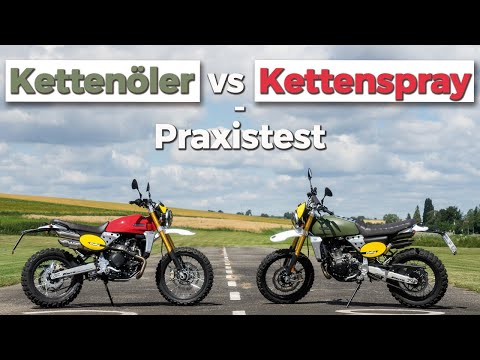
Kettenöler vs. Kettenspray im Praxistest - FANTIC Caballero 500 Rally I MOFESSOR Vergleich
1
Kettenöler vs. Kettenspray im Praxistest - FANTIC Caballero 500 Rally I MOFESSOR Vergleich
2
Kettenöler vs. Kettenspray - Zwischenstand 1500 km - FANTIC Caballero I MOFESSOR
3
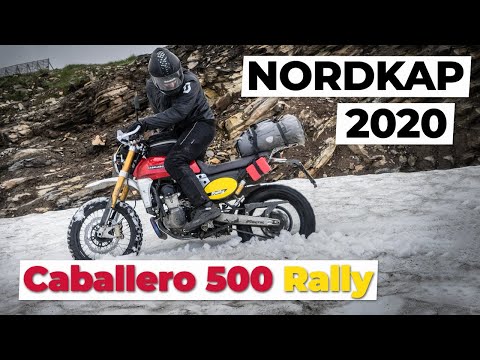
Caballero 500 Rally am Nordkap - 7000KM in 8 Tagen | Kettenöler vs. Kettenspray im Praxistest
4
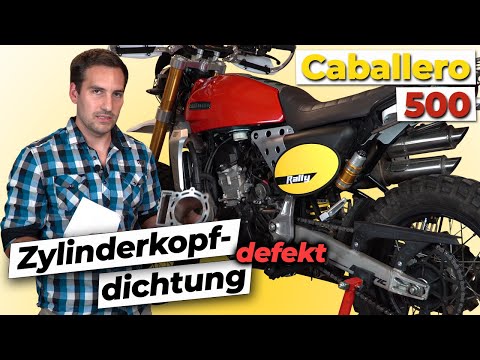
FANTIC Caballero 500 - Defekte Zylinderkopfdichtung und Inspektion I Kettenöler vs. Kettenspray
5
FANTIC Caballero - Kaufempfehlung? I Rückblick auf 23.000km Caballero 500 Rally
6
FANTIC Caballero | Fragen, Antworten, Fazit | Kettenöler vs. Kettenspray Abschlussbericht
How much work is chain spray, how much is a chain oiler?
Over 15,836 km, the Caballero running chain spray took 305 minutes of working time, the Caballero with the MOFESSOR 248 minutes – including the 120 minutes for installing the chain oiler.
More telling than the final figure is how it developed. At 11,500 km the score was 218 to 221 minutes, effectively level: the chain oiler had only just worked off its installation time. From there the curves diverge, because installation happens once while lubricating happens again and again. Every lubrication cycle costs around four minutes, and the red Caballero needed 51 of them over the test. In the same period the chain oiler was topped up seven times, 20 to 45 ml each time.
Extend the test to 30,000 or 50,000 km and it is clear where this leads: the one-off effort stays constant, the recurring effort does not.
How much lubricant is consumed?
The Caballero with chain spray got through a good three cans of S100, roughly 1,300 ml; the Caballero with the MOFESSOR used 204 ml of chain oil.
Scaled to a comparable distance, that is around 80 ml of chain spray against 12.5 ml of chain oil per 1,000 km. On tour the difference is a practical one: a 400 ml can takes up luggage space and is empty after about 5,000 km. Depending on the version, the oil reservoir holds 60 or 120 ml and therefore covers at least 5,000 or 10,000 km respectively.
What does chain spray cost, what does a chain oiler cost?
On consumables alone, chain spray costs €3.62 per 1,000 km and chain oil €0.39 – a factor of 9.3. That figure describes running consumption only, not the purchase.
Calculated in full, the balance over 15,836 km looks like this: €77.86 on the spray side for four cans of chain spray and two cans of chain cleaner. €142.85 on the oiler side, covering the MOFESSOR itself, one can of chain cleaner and the chain oil topped up, less the 250 ml included with the unit. On balance, then, the chain oiler was the more expensive option over this period.
That calculation leaves out one point: after the test the chain oiler is not used up, it is still there. Put a conservative €80 residual value against it and the cost comes to €63 versus €78 in favour of the chain oiler. Chain spray, by contrast, is consumed with every application and is gone once the test ends.
All prices refer to the 2020/2021 test period.
How does chain wear differ?
After 15,836 km the chain on the spray-lubricated Caballero had elongated by 0.22%, the one on the chain oiler by 0.15% – lateral slack over 20 links was 54.1 mm against 45.1 mm.
The red one – chain lubrication with S100 chain spray
| KM | Date | Chain length over 21 pins [mm] | Chain elongation [%] | Ø rollers [mm] | Chain re-tensioned [mm] | visual assessment |
|---|---|---|---|---|---|---|
| 0 | 25/06/20 | 318.00 | 0.00 | 10.21 | – | new, greased as delivered |
| 1,422 | 20/07/20 | 318.20 | – | 10.19 | 0.63 | cleaned with 1/2 can of chain cleaner |
| 5,481 | 05/08/20 | – | 0.06 | – | 0.84 | – |
| 8,458 | 18/08/20 | 318.20 | – | 10.15 | – | cush drive worn out |
| 8,473 | 12/09/20 | – | – | – | -0.42 | front sprocket replaced, chain slackened |
| 10,614 | 21/09/20 | 318.20 | – | 10.12 | 0.84 | – |
| 12,698 | 14/05/21 | – | – | – | 0.63 | surface rust on the chain |
| 13,026 | 26/08/21 | 318.20 | – | 10.10 | – | – |
| 14,005 | 02/09/21 | – | – | – | 0.63 | – |
| 15,836 | 30/10/21 | 318.70 | – | 10.03 | – | surface rust, rattling, uneven elongation 0.3 mm |
The green one – chain lubrication with the MOFESSOR chain oiler
| KM | Date | Chain length over 21 pins [mm] | Chain elongation [%] | Ø rollers [mm] | Chain re-tensioned [mm] | visual assessment |
|---|---|---|---|---|---|---|
| 0 | 25/06/20 | 318.00 | 0.00 | 10.21 | – | new, degreased with 1/2 can of NIGRIN chain cleaner |
| 1,445 | 20/07/20 | 318.05 | 0.02 | 10.19 | 0.10 | wiped with an oil-damp cloth |
| 5,501 | 05/08/20 | – | – | – | 1.00 | – |
| 8,671 | 18/08/20 | 318.05 | – | 10.05 | – | front sprocket loose, causing play in the sprocket, cush drive badly worn out |
| 8,758 | 12/09/20 | – | – | – | -0.63 | front sprocket replaced, chain slackened |
| 10,650 | 21/09/20 | 318.05 | – | 10.03 | 0.42 | – |
| 12,786 | 14/05/21 | – | – | – | 0.63 | – |
| 13,394 | 26/08/21 | 318.05 | – | 10.00 | – | – |
| 14,005 | 02/09/21 | – | – | – | 0.63 | – |
| 15,836 | 30/10/21 | 318.50 | – | 9.92 | – | uneven elongation 0.3 mm |
Final measurements after 15,836 km
| Measurement | Chain spray (red) | Chain oiler (green) | New |
|---|---|---|---|
| Chain elongation | 0.22% | 0.15% | – |
| Slack over 20 links | 54.1 mm | 45.1 mm | – |
| Chain pin Ø | 5.26 mm | 5.28 mm | – |
| Chain roller Ø | 10.03 mm | 9.92 mm | 10.21 mm |
| Roller guide Ø | 7.23 mm | 7.29 mm | – |
| Grease packing behind the O-ring | crusted residue | pasty residue | – |
| Front sprocket, tooth thickness at pitch circle | 4.05 mm | 3.54 mm | – |
| Front sprocket, tooth root width | 4.76 mm | 4.73 mm | – |
| Rear sprocket Dmin / Dmax | 252.20 / 269.45 mm | 252.50 / 269.40 mm | – |
One finding does not appear in the table because it only showed up during disassembly: on the spray-lubricated chain, the permanent grease packing behind the O-ring had all but dried out, and what was left in there at the end was mostly dirt. On the chain oiler chain, at least a grease-like substance was still present. The service life of an O-ring chain is decided by exactly that packing. Once it is gone, the joint runs dry, and no amount of external lubrication changes that.
Why do the wear figures contradict each other?
Two measurements speak against the chain oiler: roller diameter came in at 9.92 mm against 10.03 mm, starting from a new dimension of 10.21 mm, and tooth thickness on the front sprocket at 3.54 mm against 4.05 mm.
Elongation and roller wear have different causes. A chain elongates in the joint, between pin and bush, and that is where the permanent lubrication behind the O-ring does its work. Poorer lubrication shows up there as growing play. Roller and sprocket wear, by contrast, happens on the outside, where roller and tooth mesh. Two mechanisms in two places, developing independently of one another.
At the tooth mesh, the green Caballero had a defect: the front sprocket nut had not been tightened correctly at the factory. It was only noticed at 8,671 km, during disassembly after the North Cape trip – the sprocket had play, was badly scuffed on its flanks and was effectively worn out, and the cush drive was considerably more worn than on the red machine. Over several thousand kilometres this produced vibration and relative movement at the sprocket mesh, and with it additional friction.
That friction does not only affect the sprocket, it inevitably affects the other half of the friction contact as well: the chain roller. And since every roller passes through the sprocket mesh on every revolution, the damage works its way through the entire chain and sprocket set rather than a few links. How strongly shows in the roller diameter over time: up to the sprocket replacement the green chain lost 0.16 mm, the red one 0.06 mm. After that both run level, 0.13 mm against 0.12 mm. The whole difference arose in the first half of the test, while the loose sprocket was doing its work.
Following the finding, both machines were fitted with new front sprockets as a precaution, to restore a comparable baseline. The pre-existing damage to chain and rear sprocket could not be undone. The measured tooth thickness of 3.54 mm against 4.05 mm therefore does not come from the defective sprocket but from the replacement sprockets after roughly 7,100 km. Here the pre-damaged chain was the cause: run a new sprocket with worn rollers and it wears out faster.
Why were both chain and sprocket sets due so early?
2,137 km off-road and 1,600 km in the rain. Close to a quarter of the total distance ran through dirt or wet, and in this test that was by far the strongest wear factor.
The scale of it surprised us. Dirt and dust ingress, changing conditions and the hard impacts from stones and gravel act far more strongly on the chain than anything that happens on the road, where wear is comparatively even and predictable. As a rule of thumb, and explicitly as an estimate: in genuine off-road use, chain service life drops by a factor of around ten.
This mileage is therefore no benchmark for road use. A chain and sprocket set on a machine ridden mainly on tarmac lasts many times longer. The BMW S 1000 RR that we ran with a chain oiler from the first kilometre had 55,000 km on it at the change, and the chain and sprocket set still looked decent.
Why chain spray and chain oil behave differently
Chain spray has to stay put. A lubricant meant to remain on the chain at high speed needs tackifiers that make the film viscous and sticky. But whatever sticks to the chain also holds on to dust and sand. The very property that makes the spray usable in the first place is what causes more dirt to collect on the chain.
The second difference lies in how the two behave over time. The spray film is a reserve that starts being depleted the moment it is applied, by centrifugal force, airflow, water and dirt. Right after spraying it is too thick, shortly before the next application it has long been too thin. The chain oiler, by contrast, continuously adds small amounts of low-viscosity oil while you ride. The film is not used up but constantly replaced, and because the oil is not formulated to be tacky, it binds less dirt and washes part of it off the chain again. That also explains the difference in consumption: 12.5 ml per 1,000 km is enough because only what is actually lost gets replaced.
How does chain spray hold up on a long trip?
On the North Cape trip, 7,072 km in eight days, 1,100 km of them in the rain or on wet roads, the chain on the red Caballero was sprayed twelve times, so on average every 590 km or so. The chain oiler on the green machine got through just under 90 ml of oil in the same period.
Those roughly 600 km are not what would have made technical sense, they are what could be kept up. In the rain there is no load-bearing oil film left after about 100 km, off-road after 50 to 80 km. Spraying at that rhythm is simply not practical on tour. So you spray when the opportunity arises, not when the chain needs it.
Then there is the procedure itself: dig the can out of the luggage, put the bike on a stand or lift it with a second pair of hands, spray evenly, then let it flash off for around 20 minutes before moving on. With the chain oiler all of that falls away: when the road turns wet, you press a button for rain mode and ride on. How clear the difference is in everyday use showed before every longer trip in the same recurring discussion: none of us wanted to take the red Caballero.
When is chain lubrication counterproductive off-road?
In extremely dusty or muddy conditions, lubricating can increase wear rather than reduce it, because both chain oil and chain spray bind dirt particles – the spray considerably more so, thanks to its tackifiers. A concrete case from the test: chain sprayed, then straight onto a dusty track, and after a few kilometres the chain was gummed up on the outside while the rollers ran dry. That spraying could have been saved.
This applies to hard conditions only. On gravel sections, forest tracks and in light terrain, chain lubrication remains sensible and necessary. There, both the chain oiler and the spray work as intended.
The conclusion from this is not to stop lubricating altogether, but to get the timing right. Raising the oil quantity in the middle of the dust achieves little. What matters is getting an oil film back onto the chain after the off-road section, before the next fast stage. With the chain oiler that is a button press and flush mode; with chain spray you have to remember it and stop.
Chain oiler or chain spray – which is better?
The chain oiler wins this comparison: less working time, one sixth of the lubricant consumption, lower running costs and continuous lubrication that needs no attention on the road.
On wear the picture is more nuanced. In favour of the chain oiler are the chain elongation at 0.15% against 0.22% and the slack at 45.1 mm against 54.1 mm, plus the grease packing still present behind the O-ring. With just under 25% off-road and wet riding, dirt ingress was the dominant wear factor and largely masked the differences between the two lubrication methods. Both chain and sprocket sets were due at the same mileage.
On the road it looks different. We have been running chain oilers on our own machines for more than 15 years, over several hundred thousand kilometres, and feedback from our customers matches that: continuously lubricated chains there regularly reach two to three times the service life of chains maintained with chain spray.
Who is a chain oiler worth it for?
For predominantly road use the recommendation is clear: fit a chain oiler. Longer chain service life, no more lubricating by hand. A single chain and sprocket set saved pays for the purchase, and the time saved comes on top.
For touring and mixed use – TransEuroTrail, Alpine trips, anything with an off-road share – a chain oiler makes a great deal of sense too. What counts here above all is the practical gain: no chain spray in the luggage, no spraying at the roadside, no waiting for it to flash off. And after an off-road section there is automatically an oil film back on the chain before the next high-speed stage. That is precisely the moment when a dry chain suffers most.
For off-road enthusiasts with a high share of dust and mud, a chain oiler is not strictly necessary. In that kind of use, dirt ingress largely determines wear, not the lubrication method. The chain and sprocket set is a wear part with a short interval anyway. Lubricating is still required here as well, at the latest when you head back onto the road. And for that the same applies as for touring: one button press puts oil back on the chain, with no can in the luggage and no stop at the roadside.
Does the chain oiler fit my motorcycle?
For more than 160 motorcycle models, photos and the positions of oil reservoir, metering valve and nozzle are available, each documented on the actual machine.
Products in this article

Top


