
Power Relay on a Motorcycle: Switching Auxiliary Loads Safely
A GPS device or a USB socket can be connected straight to a switched 12 V wire without any trouble. With auxiliary lights, heated grips or a compressor it becomes risky: an existing vehicle wire is sized for its own job and can be overloaded by an additional load. Tapping the battery permanently instead means the device keeps drawing current at standstill and drains it. The power relay solves both problems by separating the control current from the load current.
The principle: separating control current and load current
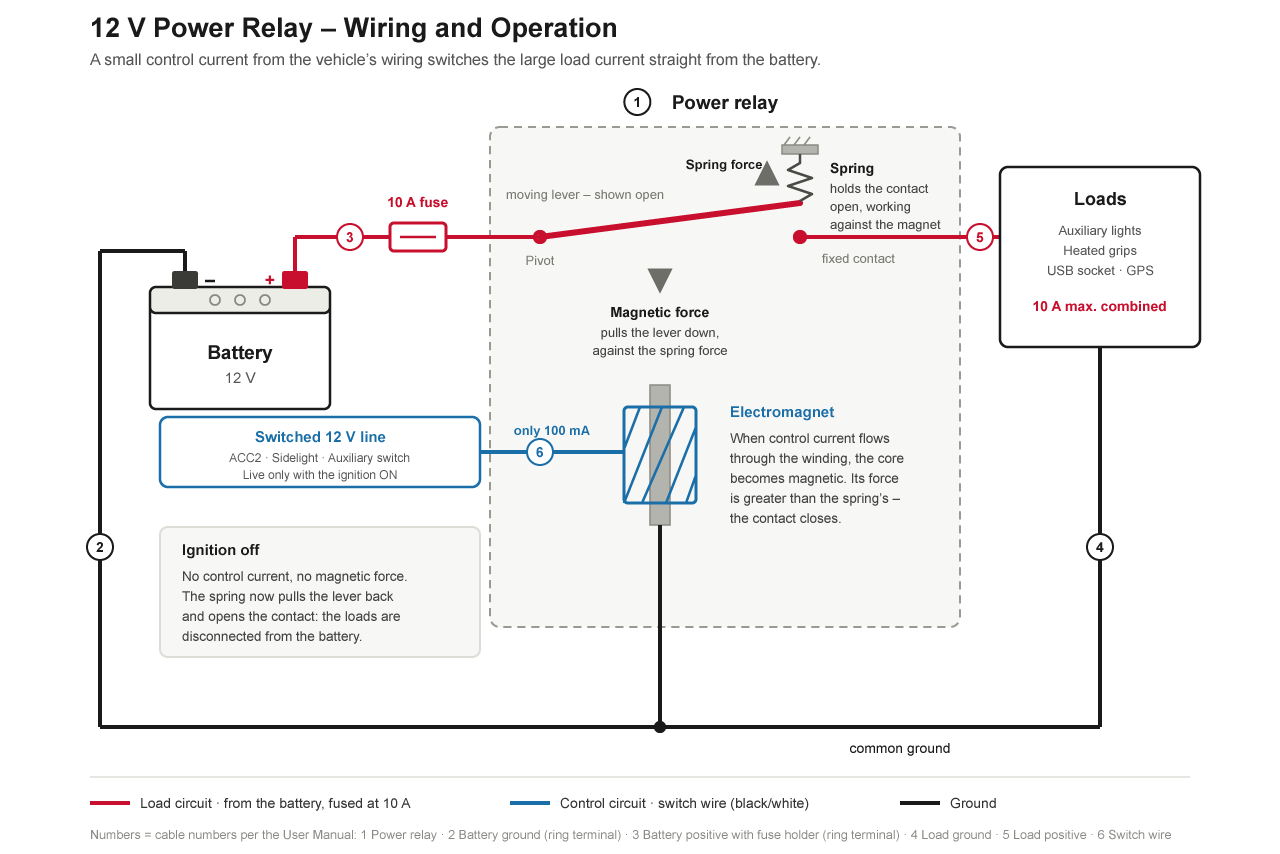
A relay is essentially an electrically operated switch. A switched 12 V wire – the trigger wire – energises the relay and draws only a small current in doing so. As soon as voltage is present on that wire (that is, with the ignition on or the switched live active), the relay closes the load circuit. This load circuit is fed straight from the battery through a wire rated for the job.
The high load current therefore never passes through a thin vehicle wire unsuited to accessories, but through its own adequately sized and fused path. At the same time the control side stays tied to the ignition. Once the ignition is switched off, the voltage on the trigger wire drops away, the relay opens, and the loads are completely isolated from the battery. Nothing draws load current at standstill.
When a relay is worth it and when it is not
A power relay belongs between the battery and the load as soon as high-draw accessories are involved: auxiliary lights, heated grips, GPS devices with add-ons, multi-port USB charging sockets or any combination of these. It is equally sensible where no sufficiently rated switched wire is available but a switched control signal is (from the ACC2 connection, the sidelight or an auxiliary switch, for instance).
A relay is not needed for individual small loads with a low current draw that can hang off an existing switched connection without concern. A retrofit instrument such as the CUMPAN, drawing 0.1 A at most, is a typical example; here the direct connection via the matching connector is enough.
Technical data of the BOSCH power relay
The power relay available in the range comes ready to connect with a wiring harness and uses a BOSCH relay rated for a guaranteed 100,000 switching cycles.
| Property | Value |
|---|---|
| Maximum current (load) | 10 A / 12 V |
| Relay rated up to | 20 A / 12 V |
| Fusing | 10 A blade fuse |
| Trigger wire current draw | 100 mA / 12 V |
| Switching cycles (guaranteed) | 100,000 |
| Scope of delivery | 1× power relay with wiring harness |

The 10 A blade fuse limits the load current; the relay itself is rated up to 20 A and therefore copes with brief inrush currents as well. The trigger wire draws 100 mA. Practically any switched vehicle wire can supply that control current.
Connection
The connection is made in two separate circuits. The load (auxiliary lights, USB charging socket, GPS, heated grips) is connected directly to the blade terminals provided on the power relay. Alternatively, a WAGO clamp can be used to make the joint.
The trigger wire (black and white cable) is connected to a switched 12 V wire. The signal can come from an ACC2 connection, the sidelight or an auxiliary switch, for example. All that matters is that this control wire is switched, so the relay comes on and off with the ignition.
For a tidy, protected cable run, a spiral band for bundling is worth adding.
- 12 V switched power relay (BOSCH) – ready to connect with wiring harness
- 12 V connector – model-specific – for connecting the trigger wire
- WAGO clamp – for joining the loads
Relay versus Battery Guard
Relays and the Battery Guard are occasionally confused, but they do different jobs. The relay switches on the load side in response to a control signal, usually the ignition, and disconnects the loads as soon as that signal disappears. The Battery Guard, by contrast, responds to the state of charge of the battery and disconnects loads when the voltage drops below a set value, regardless of the ignition. The two can be combined: the relay relieves the vehicle wiring and ties the loads to the ignition, while the Battery Guard additionally protects the remaining capacity. More on this in the article Battery Guard for motorcycles: deep discharge protection for auxiliary loads.
Conclusion
As soon as high-draw accessories come into play, the relay is the clean solution: the vehicle wire carries only the 100 mA control current, the load current runs over its own fused path straight from the battery, and switching off the ignition leaves the loads completely isolated again. A single component thus takes care of what otherwise either overloads the vehicle wiring or flattens the battery at standstill.
Note: the total current draw of the connected loads must stay within the fuse rating. Information supplied without guarantee – when in doubt, check the cable cross-section and the fuse.
Products in this article


Top rated

Top rated

Best sellers


