
FANTIC Caballero 500 on the Dyno: New vs. Old – Minarelli vs. Zongshen
For the Caballero 500, Fantic promises more power from model year 2025 onwards – a new Italian Minarelli engine in place of the previous Chinese Zongshen. We wanted to know how much of that factory claim really reaches the rear wheel, so we measured both generations on the same rolling-road dyno: 2019/20 Zongshen (Euro 4) against 2025 Minarelli (Euro 5+). We logged not only rear-wheel power but, in parallel, the exhaust gas via an external wideband lambda sensor – which tells you not just how much the engine makes, but also how rich or lean it is tuned.
This report sums up the measurements in detail and rounds out the video with figures, charts and background to read up on.
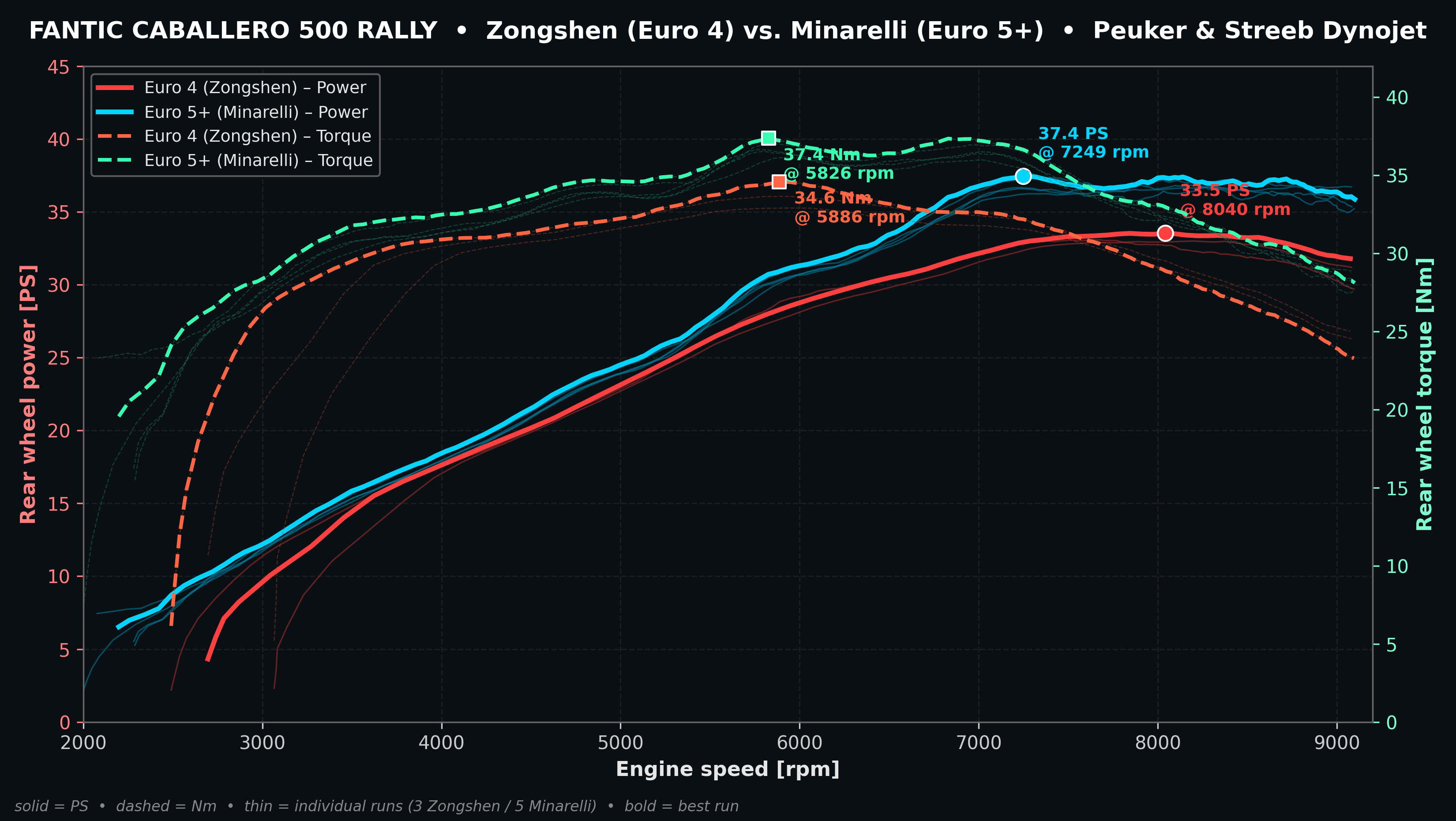
Engine model history
From 2018 to 2024, Fantic built the Caballero 500 with a single-cylinder engine of Chinese production: the Zongshen NC450, 449 cm³ (94.5 × 64 mm), a single overhead camshaft (SOHC), four valves. The NC450 isn't a pure Fantic engine – the same base engine also powers the Kove 450, among others. Within the Caballero range there were two states of tune. From 2018 to 2020 the engine ran as Euro 4. Euro 5 arrived in 2021 – the same base engine, but with new mapping, a larger throttle body (40 mm instead of 34 mm), a slipper clutch, a revised exhaust/cat and longer-geared fifth and sixth gears.
From 2025 – according to Fantic – a new Italian Minarelli engine sits in the frame. Viewed soberly, though, you can see straight away from the outside that the base engine was carried over unchanged from Zongshen. What is new are the cylinder and cylinder head: 463 cm³ (96 × 64 mm), twin overhead camshafts (DOHC) instead of one, a 12.5:1 compression ratio. Added to that a second lambda sensor – required by Euro 5+ –, a Ride-by-Wire throttle body and an additional oil cooler. So it is not an all-new engine, but a thoroughly reworked head on a familiar bottom end.
| Key data | 2018–2024 Zongshen | 2025 onwards Minarelli |
|---|---|---|
| Displacement | 449 cm³ (94.5 x 64 mm) | 463 cm³ (96 x 64 mm) |
| Valvetrain | SOHC, 4 valves | DOHC, 4 valves |
| Compression | 10.8 / 11.5:1 | 12.5:1 |
| Fuel delivery | Injection, 34 mm | Injection, 40 mm, Ride-by-Wire |
| Lambda control | one sensor | two sensors (Euro 5+) |
| Cooling | Water | Water + additional oil cooler |
| Emissions standard | Euro 4 (2018–20) / Euro 5 (2021–24) | Euro 5+ |
| Factory output (engine) | 40 hp | 44.4 hp |
Transmission and gearing
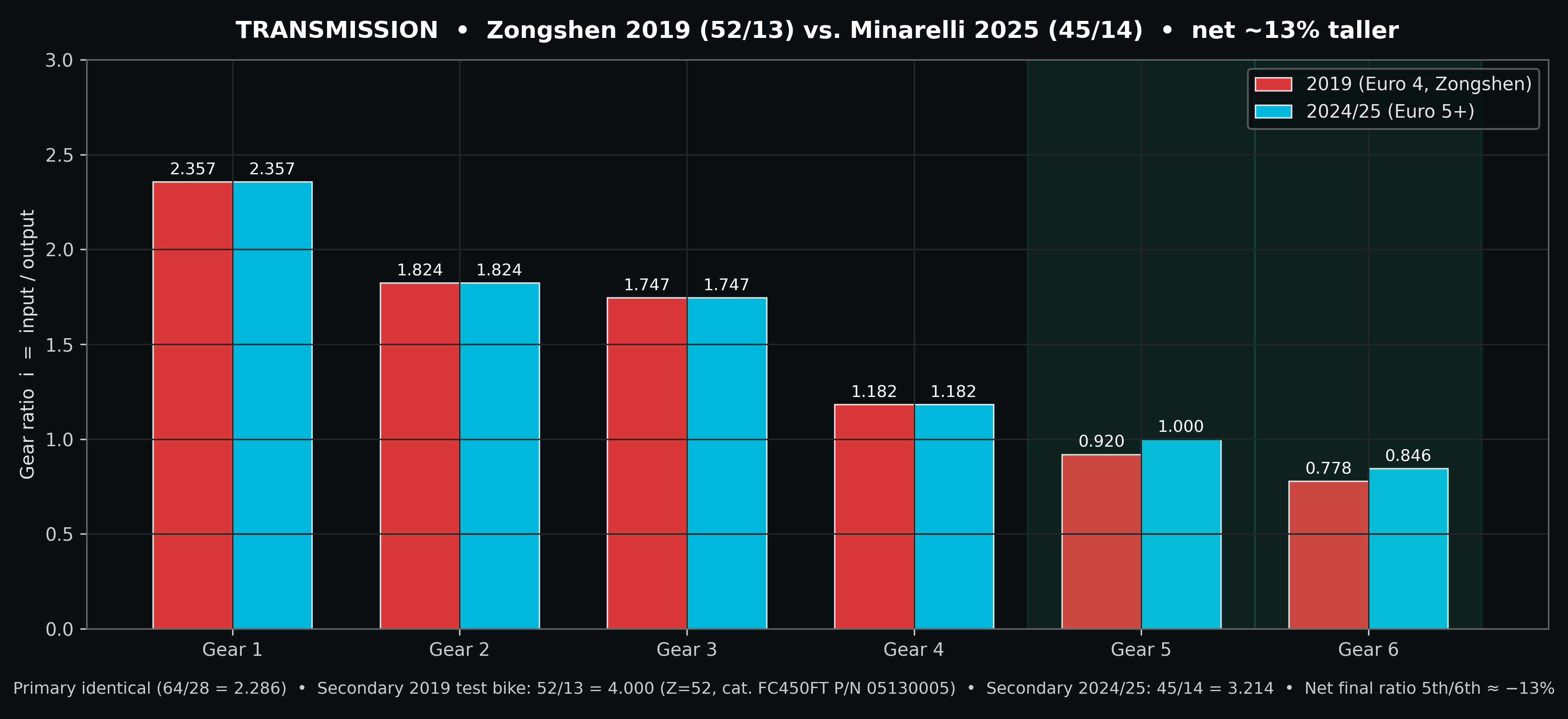
The model change brought work not only on the engine but also on the overall gearing. The primary drive is unchanged (64/28 = 2.286), and the internal ratios of the first four gears have stayed identical. What has been made longer are fifth and sixth gear as well as the final-drive ratio: our 2019 test bike ran 52/13 (final ratio 4.000), the 2024/25 model 45/14 (3.214). In total that yields a roughly 13 percent longer final ratio in fifth and sixth gear. The data are taken from Fantic's user manuals.
The dyno setup
Measurements were taken on a Dynojet rolling-road dyno at Peuker & Streeb. The runs were carried out by a highly experienced dyno operator with a track record in the IDM. Rear-wheel power was recorded; in parallel, an external wideband lambda sensor in the tailpipe, independent of the engine management. This shows us not only how much power reaches the wheel, but also how rich or lean the engine runs the mixture.
Both machines were brought up to operating temperature and then several full-load runs were recorded in fifth gear – with no technical changes or breaks between measurements. There are eight full-load runs in total: three with the Zongshen, five with the Minarelli. We also measured the Minarelli in the new All-Terrain mode; on models up to and including 2024 the mapping cannot be changed.
Mileage matters for context. The Euro 4 Zongshen has already covered around 19,000 km, while the new Euro 5+ Minarelli stands at about 900 km and is thus only just run in. No meaningful power increase with further mileage is to be expected from the Minarelli. Conversely, at 19,000 km the Zongshen is probably already past its optimum – small singles of this class rarely run more than 50,000 km, and an overhaul is often due before that, especially under high thermal load. So this is deliberately not a new-against-new comparison, but an as-is one: a new Minarelli against a well-ridden Zongshen.
The core figures: power and torque
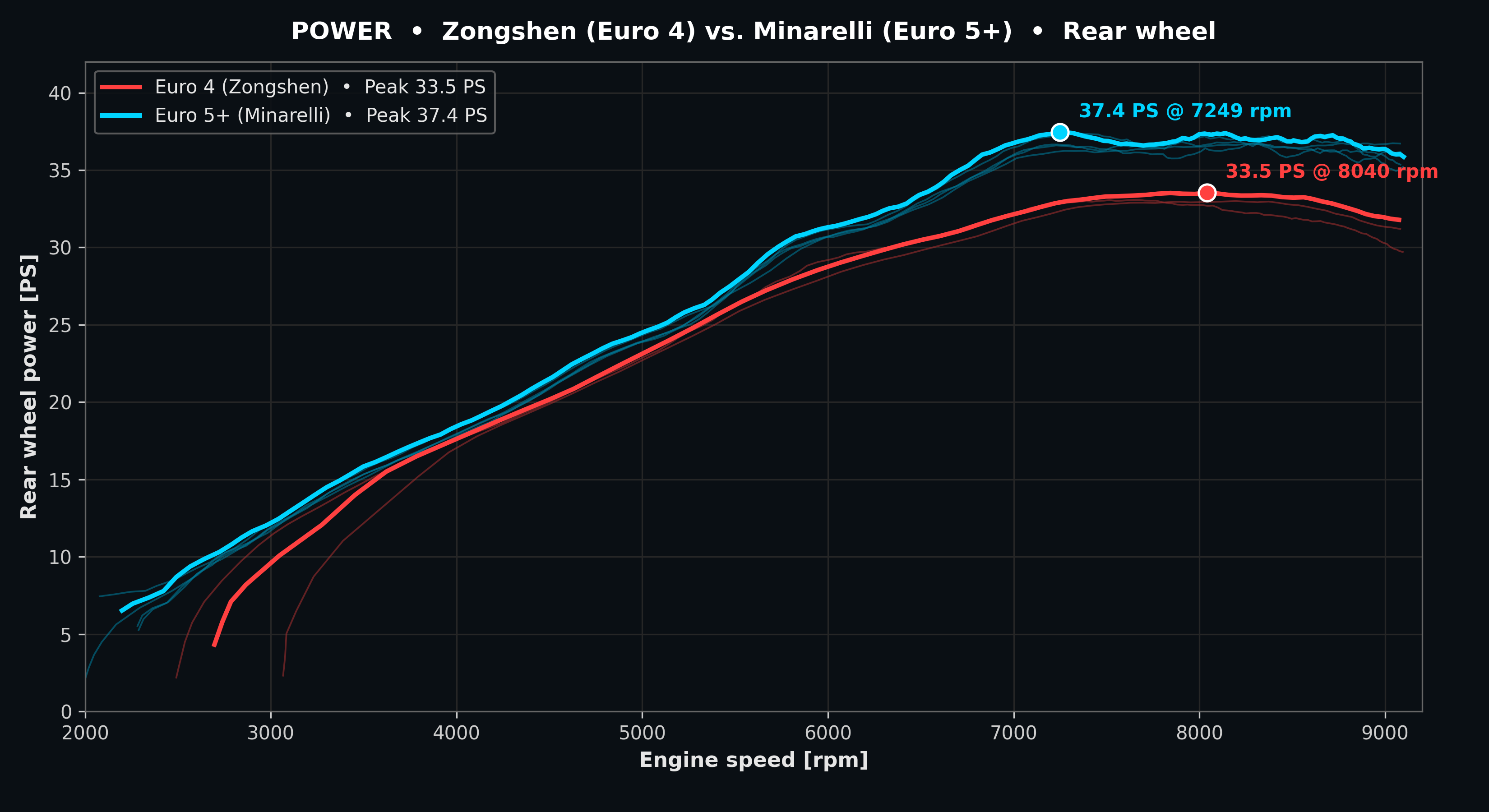
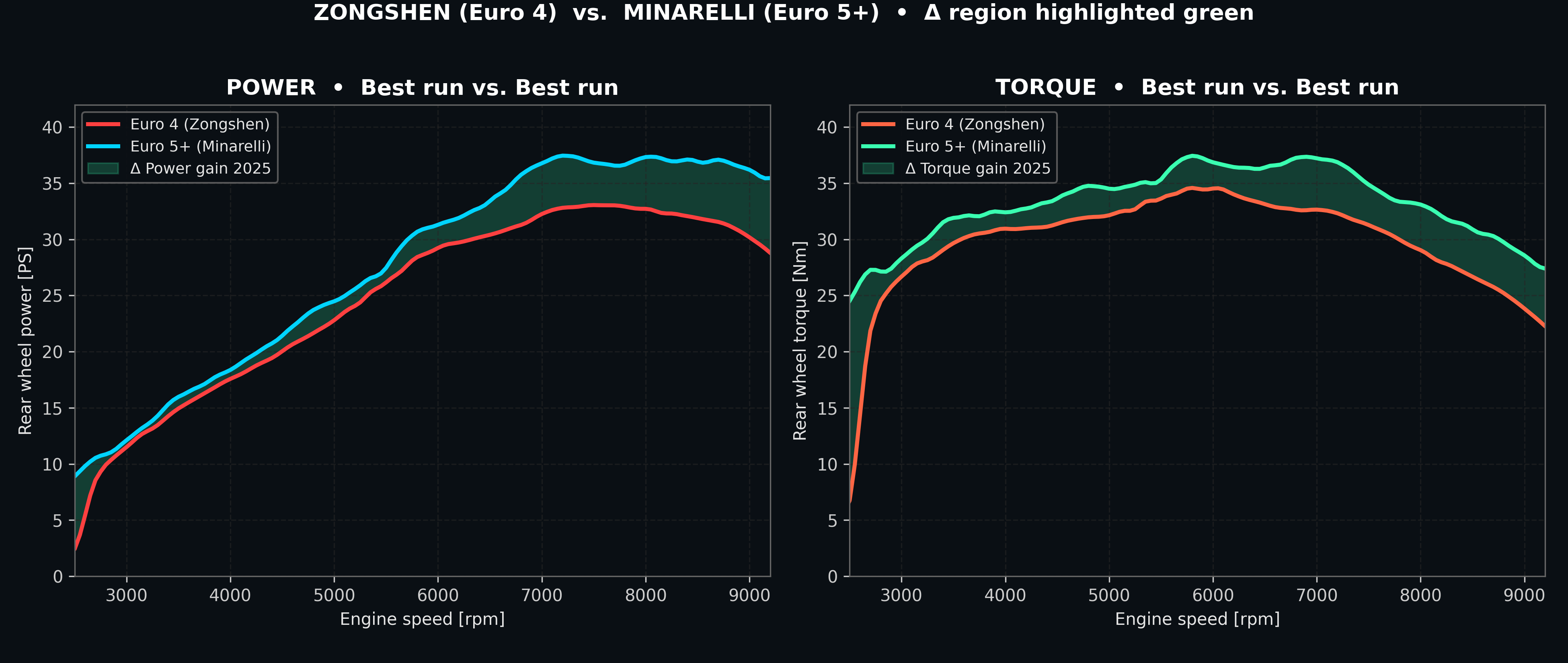
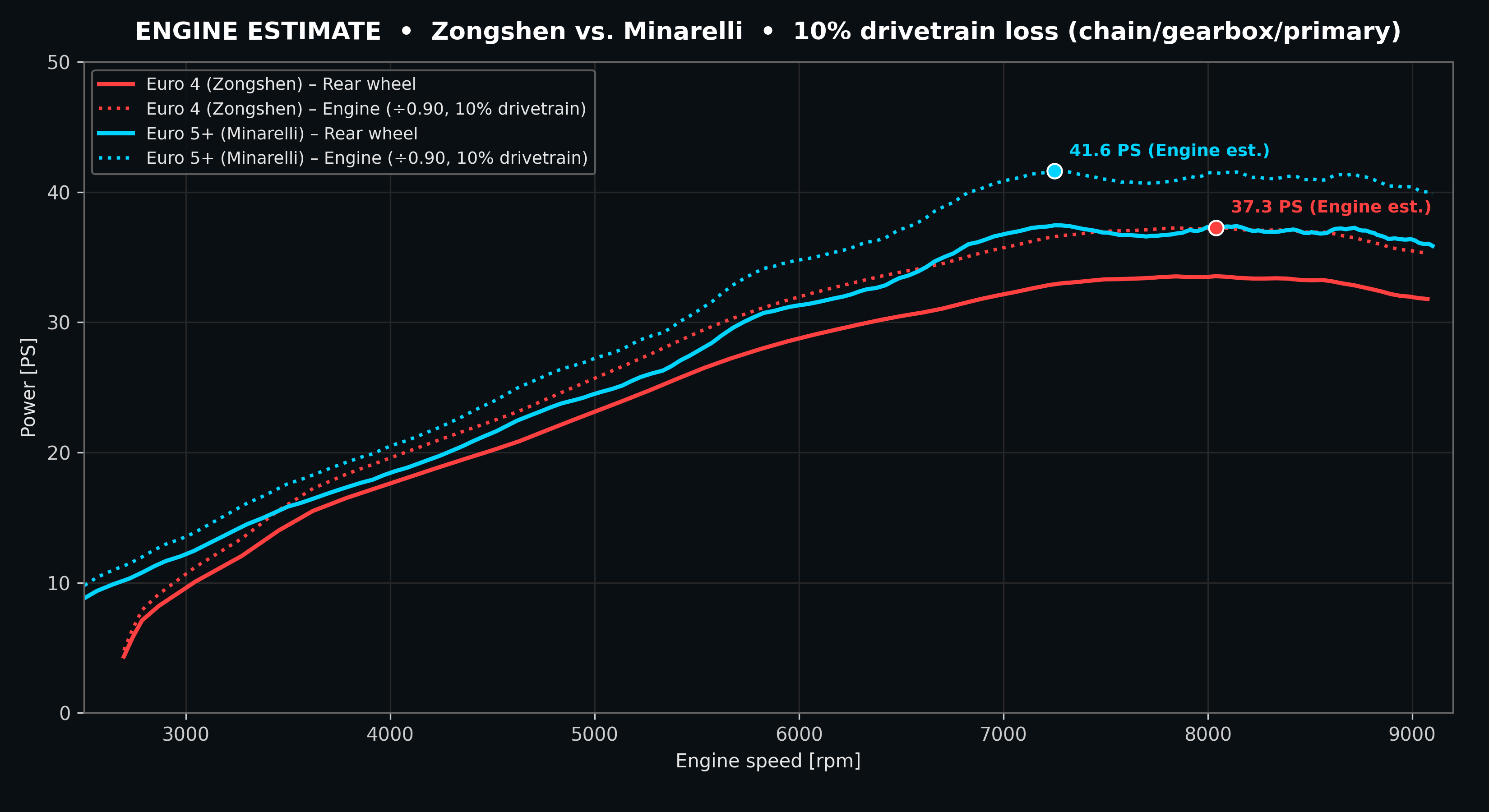
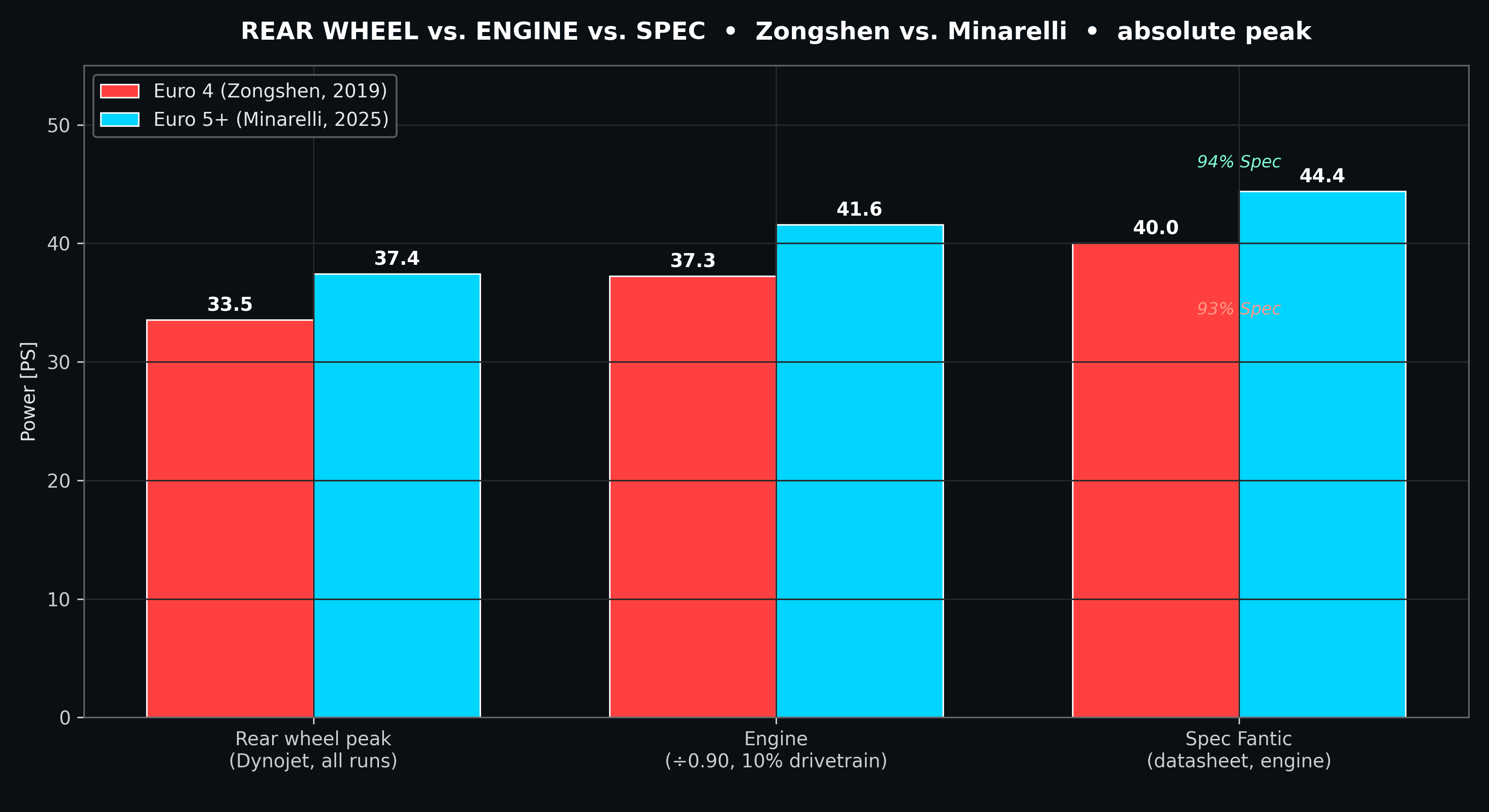
The best valid run of the Zongshen comes in at 33.5 hp at the rear wheel, that of the Minarelli at 37.4 hp. That is +3.9 hp for the new engine, i.e. around 12 percent more peak power (best run). The Zongshen reaches its maximum at about 8,040 rpm, the Minarelli at 7,249 rpm.
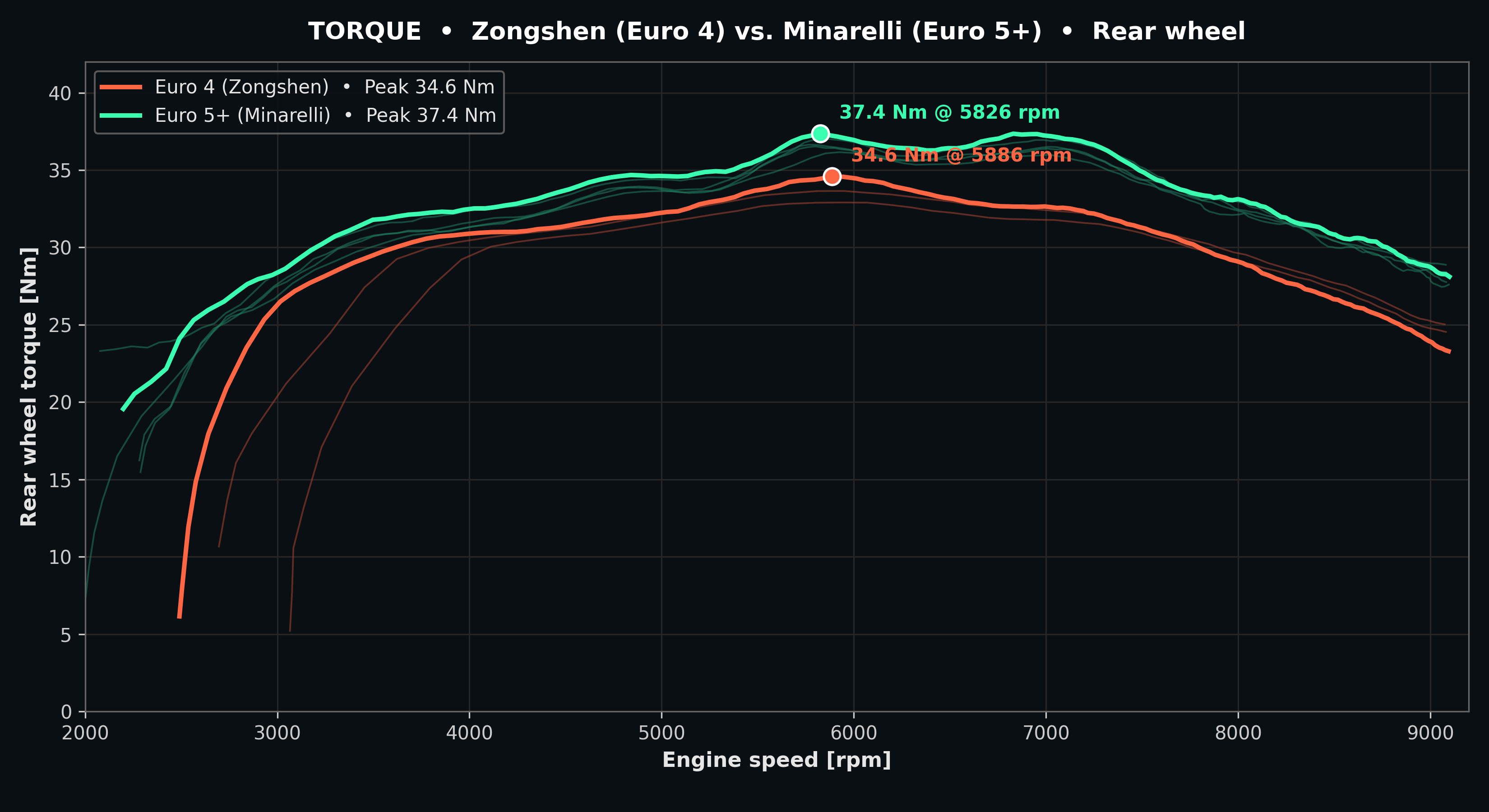
On torque the Zongshen sits at 34.6 Nm, the Minarelli at 37.4 Nm – a gain of 2.78 Nm or around 8 percent. Both engines have their torque peak at about 6,000 rpm, but the Minarelli holds the torque for longer. In practice this means: especially at higher speeds and engine speeds from about 5,500 rpm, the new engine feels noticeably stronger.
Where exactly the gain sits is shown most clearly by the delta plot. Up to around 4,000 rpm the difference is small – that is the range in which many people ride day to day. Only above it does the green area between the two curves open up, both for power and for torque.
All-Terrain mode: same power, softer throttle response
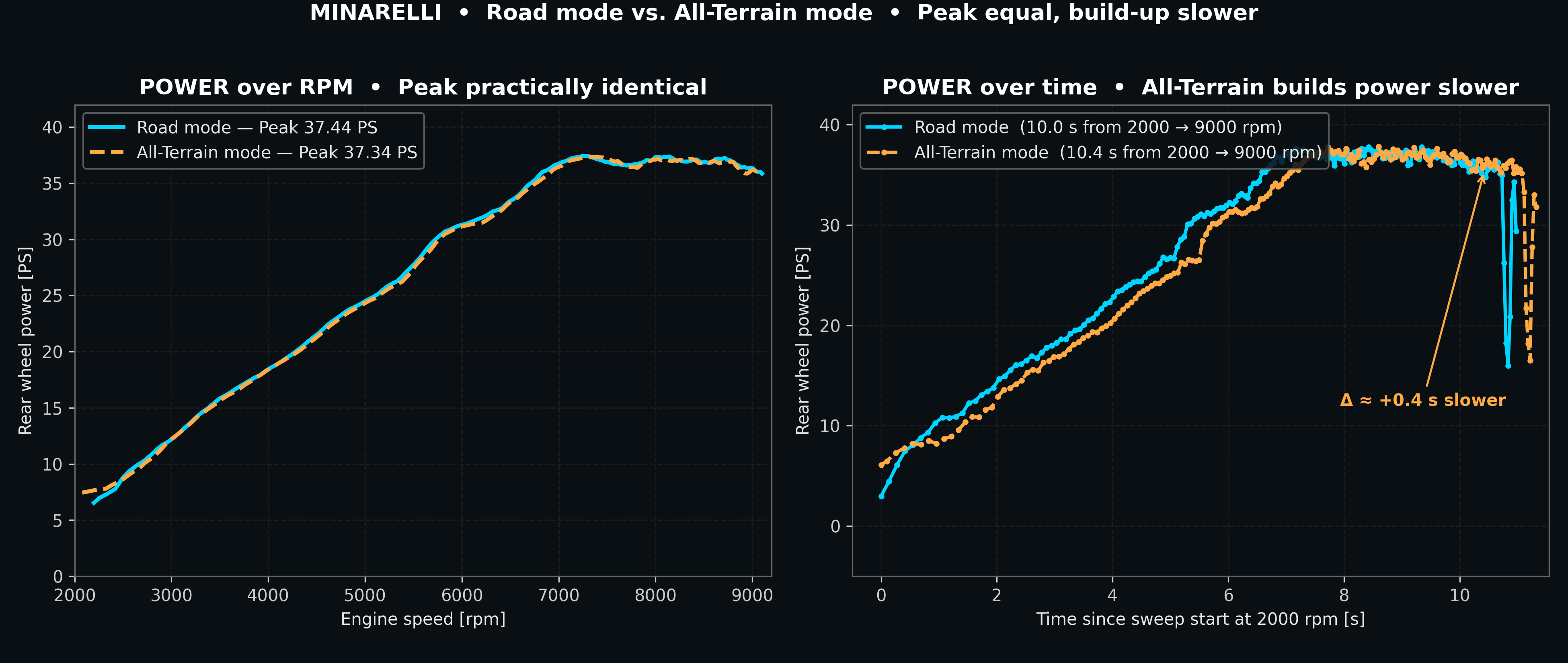
We also measured the Minarelli in All-Terrain mode. In the chart, Road mode and All-Terrain mode lie practically on top of each other, including in peak power (37.44 hp versus 37.34 hp). The reason is technically clear: All-Terrain mode changes only the throttle map of the “Ride by Wire” system – same throttle-grip angle, smaller throttle opening, softer tip-in phase. The actual engine calibration – injection quantity, ignition timing, target lambda – stays unchanged. At fully open throttle, therefore, the same power is on tap in both modes.
On the dyno the throttle is pinned wide open, so the mode difference comes out small. It only becomes visible over time: in Road mode the bike spins the sweep from 2,000 to 9,000 rpm in around 10.0 seconds, in All-Terrain mode in 10.4 seconds – about 0.4 seconds slower. When pulling away and with constantly changing throttle positions this difference is clearly noticeable in everyday riding, but it changes nothing at peak power.
Low-rev range
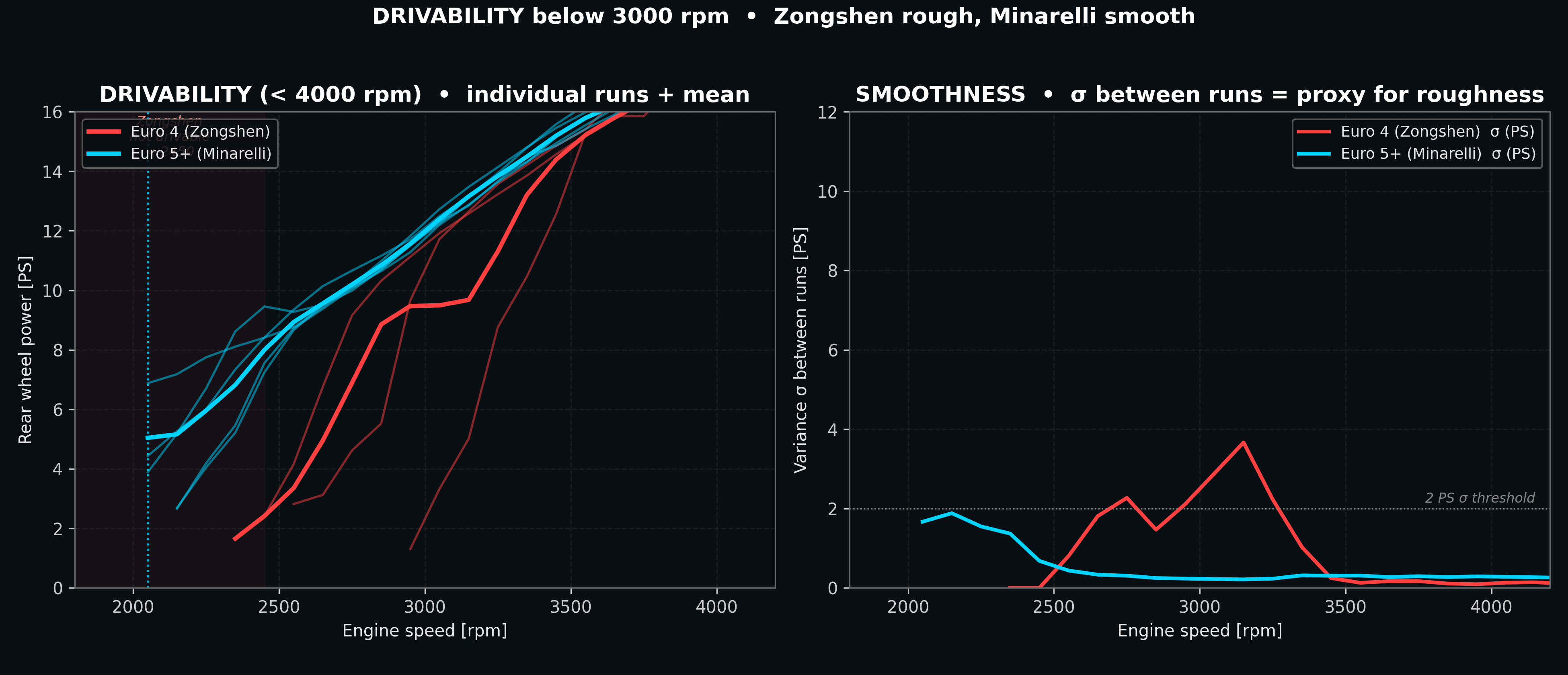
The Zongshen is known for its character down low: rough, harsh, snatchy below 3,000 rpm. This shows up in the measured data too. We evaluated the spread between individual runs in the 2,000 to 4,000 rpm range. On the Zongshen it rises around 3,000 rpm to as much as roughly 3.5 hp and clearly exceeds the 2 hp threshold. The Minarelli stays below that throughout – at the bottom end around 2,100 rpm at just under 2 hp, and from about 2,600 rpm only around 0.3 hp. In this range the new engine therefore runs far more evenly and reproducibly.
That explains why the Minarelli feels tamer in town and when pulling away: from 2,000 rpm it doesn't pull hard, but it pulls cleanly. The Zongshen only begins to build any drive at around 2,450 rpm. That makes the Minarelli usefully usable some 400 rpm earlier.
The mixture: why the new engine runs so rich
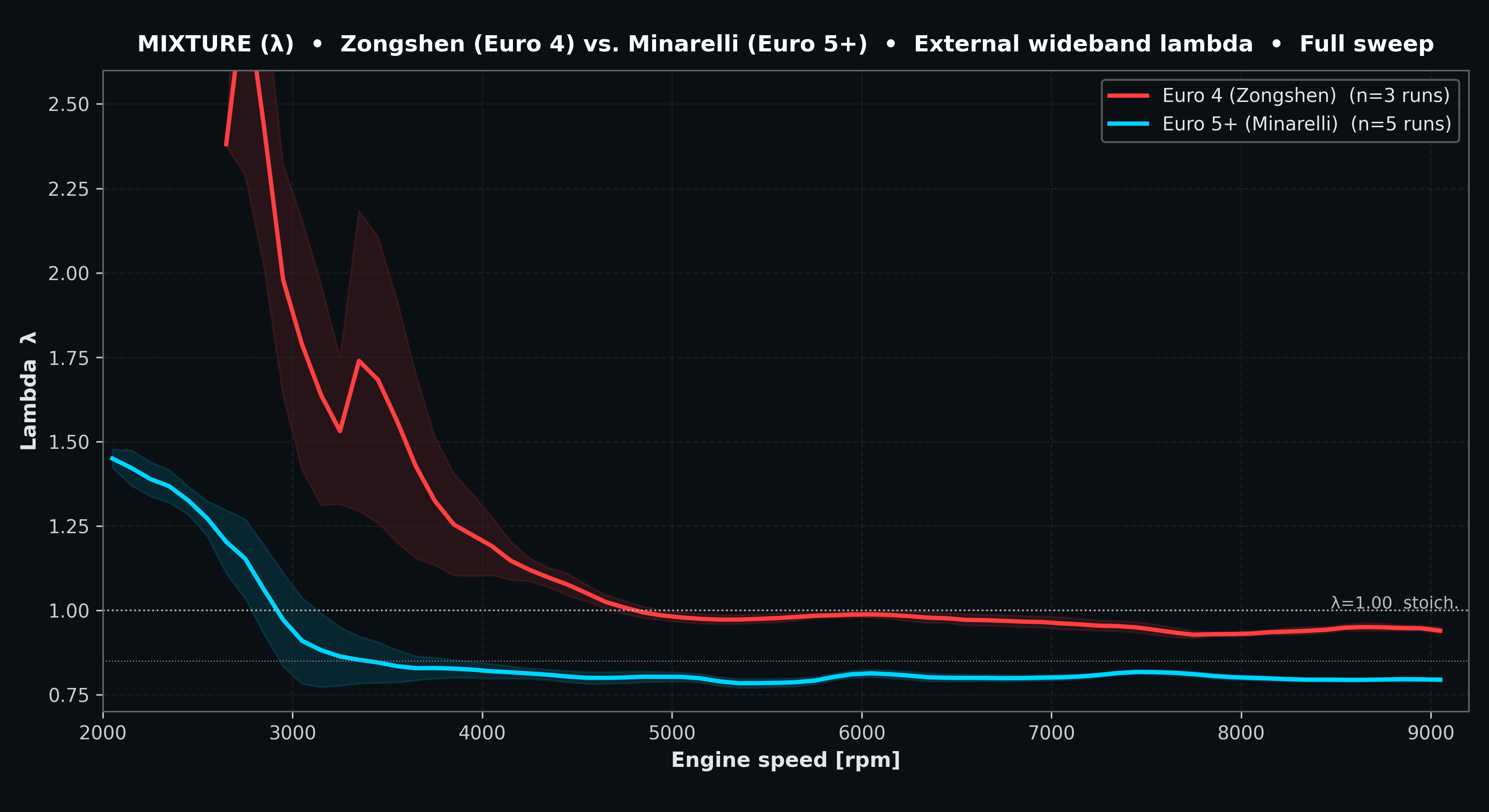
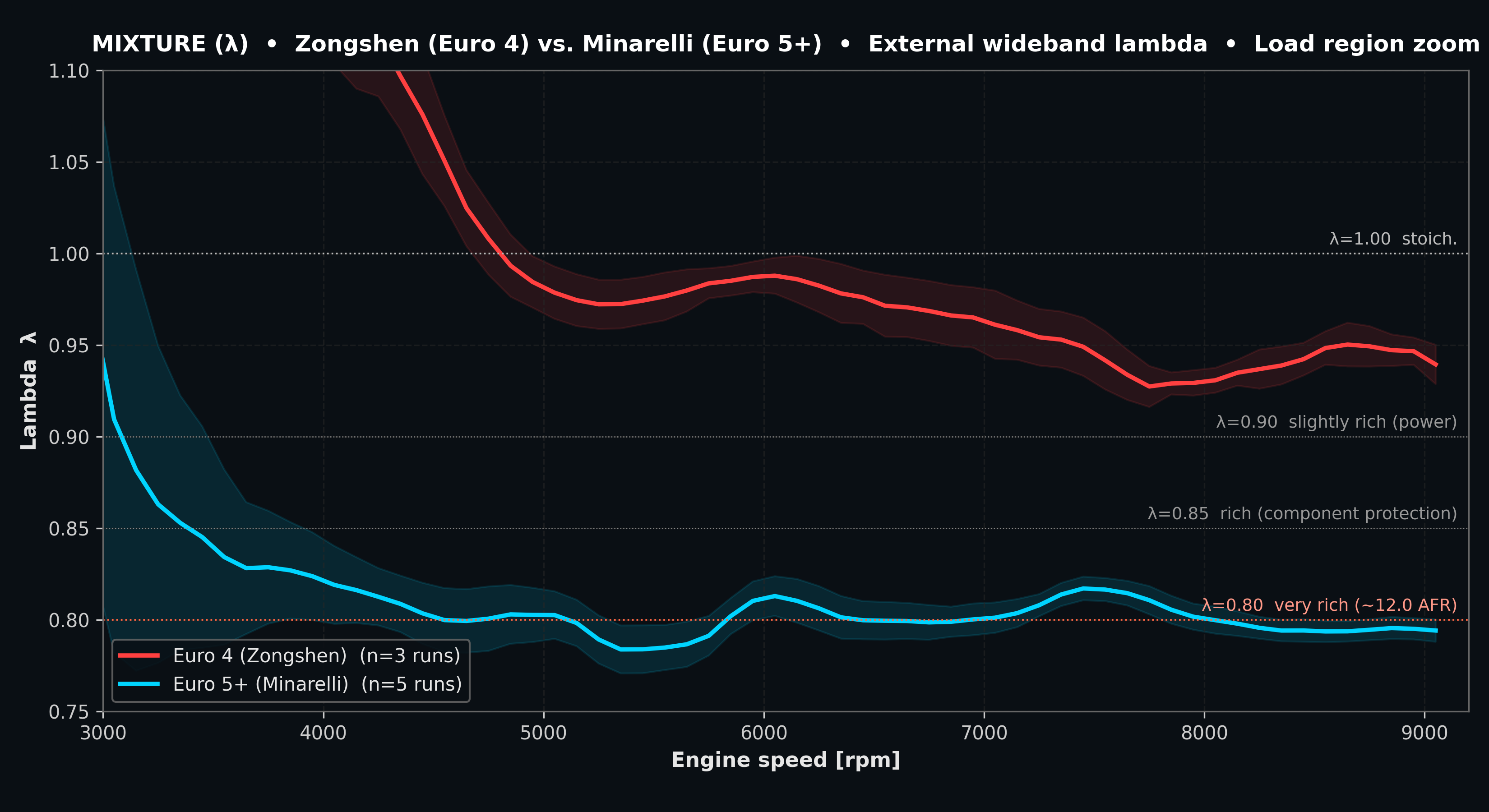
With the wideband lambda sensor in the tailpipe, the fuel-air mixture can be assessed directly in the exhaust gas. What is measured is a full-load sweep: throttle wide open, the drum is accelerated. On the dyno the sweep only starts at around 2,000 rpm, on the Zongshen not until about 2,400. Idle at 1,600 rpm lies below that and was not measured here. The values are meaningful from about 3,500 rpm – below that the mixture first leans out due to the throttle being snapped open and the brief excess of air, until the system corrects and a stable full-load mixture settles in. The Minarelli's electronic throttle additionally dampens this effect.
This is where the biggest difference in engine calibration shows. The Zongshen starts later, takes a little longer to settle to just under lambda 1, and then stays in the range λ ≈ 0.94 to 0.98. Technically that is a rich mixture (λ < 1), but for a full-load measurement we would call this value a rather lean tune – maximum engine power is usually only reached at around λ = 0.88.
The Minarelli paints a completely different picture. Across the whole load range it runs consistently and markedly richer, i.e. it uses less air mass per kilogram of fuel. For context: at λ = 1, the stoichiometric mixture, 14.7 kg of air are burned per kilogram of fuel. Under full load the Minarelli sits at λ ≈ 0.80 – that corresponds to an air-fuel ratio (AFR) of around 12:1 and is already a very rich mixture, on the edge of soot formation. In the upper full-load band (about 6,500 to 9,000 rpm) the Zongshen sits at roughly λ 0.94, the Minarelli at roughly λ 0.80 – so the mixture is about 18 percent richer.
For the periodic roadworthiness inspection this isn't decisive. It measures stationary at idle, and there every stock ECU is required by law to hold lambda 1 – a different operating point from our full-load measurement.
So why does the Minarelli run the rich full-load mixture? Two reasons. First, more power: a richer mixture additionally cools the combustion chamber, allows more ignition advance and delivers a few percent more at the top end. Second, component protection. The old Zongshen is known for making the header glow red-hot under prolonged full load – a consequence of its lean tune. The Minarelli deliberately protects its higher-compression DOHC head with the richer mixture: evaporating fuel cools the exhaust port.
The consequences are moderately higher fuel consumption and poorer exhaust after-treatment via the three-way catalytic converter in the full-load range. In return the engine is thermally more relaxed, the valves last longer, and more thermal headroom remains. The spark-plug change fits this picture too: the NGK ER9EH-6N was replaced by a more durable iridium plug, the NGK LMAR9AI-8. From experience we also recommend the matching iridium variant in the Zongshen engine (2018–2024): NGK ER9EHIX.
Rear wheel or engine? A look at the factory figure
A dyno measures at the rear wheel. On the way there, power is lost through the chain, sprockets, gearbox and tyre flex. Exactly how much we were not able to determine by measurement. For single-cylinder motorcycles with chain drive the technical literature typically cites eight to fifteen percent. We therefore reckon on ten percent – a realistic mid-range value for a warmed-up single-cylinder enduro with a well-lubricated chain.
That works out at around 37.3 hp at the engine for the Zongshen and about 41.6 hp for the Minarelli. Fantic's spec sheet quotes 40 hp and 44.4 hp respectively. So both engines sit around 6 to 7 percent below the factory figure – not pretty, but not unusual for a dyno measurement.
Who benefits most?
Peak figures are one thing. What counts in everyday use is the added power in the rpm band you are actually riding in – and as an average across the whole band, not just at the top. That is exactly where the comparison turns out differently depending on rider type.
| Rider type | Typical rpm band | Added power (band average) | Added torque (band average) | How noticeable |
|---|---|---|---|---|
| City / commuter rider | 3,000–5,500 rpm | +1.20 hp (+6.5%) | +2.48 Nm (+8.3%) | noticeable |
| Touring rider / back roads | 4,500–7,000 rpm | +2.02 hp (+7.5%) | +2.58 Nm (+7.9%) | noticeable |
| Off-road / gravel rider | 4,000–6,500 rpm | +1.42 hp (+5.8%) | +2.08 Nm (+6.4%) | noticeable |
| Sporty tarmac rider | 6,500–9,000 rpm | +3.88 hp (+12.0%) | +3.64 Nm (+12.2%) | very pronounced |
| A2 beginner | 3,000–7,500 rpm | +1.97 hp (+8.3%) | +2.83 Nm (+9.1%) | noticeable |
| Motorway commuter 110–130 km/h | 6,000–8,500 rpm | +3.41 hp (+10.7%) | +3.43 Nm (+11.0%) | very pronounced |
The biggest beneficiaries are those who ride sportingly or use the motorway at 110–130 km/h – there the roughly +11 to +12 percent fall squarely within the rpm window in use. For tourers and off-roaders the gain of about +6 to +8 percent is real, but moderate. The better rideability below 3,000 rpm does not feed into these averages – it acts on top, and precisely where city and beginner riders are out and about.
Real-world impression: 2,000 km, of which 1,100 km in Sardinia
So much for the measurements – now to the real world. We rode the 2025 bike for two thousand kilometres, 1,100 km of them off-road in Sardinia. These are the things you can't experience on the dyno.
The most obvious change to the engine is the throttle response. It is noticeably softer and easier to meter than on the predecessor. Fantic took the well-known criticism of the old models' rideability on board and, through the combination of Ride-by-Wire and DOHC head, implemented a clean, early load take-up from around 2,000 rpm – without the stumbling or juddering the Zongshen shows in this range. Overall the engine feels more refined and runs more smoothly. Technically that is progress; emotionally it becomes a little more matter-of-fact in return: the hard single-cylinder thump of the Zongshen is missed a touch.
You feel the extra power at the top end, but only when you call on it – when overtaking or riding briskly. In the band actually used most, from 3,000 to 5,000 rpm, both machines feel very similar; the difference there comes out smaller than the peak delta would suggest. Across the full 2,000 km the engine ran faultlessly in all conditions – no hesitation, no cold-running weakness, no misfires on load changes.
One point of criticism remains: All-Terrain mode. It is awkward to activate and, without the manual, not intuitive out in the terrain. You need it because it is the only way to switch off the ABS – and unfortunately it softens the throttle mapping at the same time. Because the engine is finely meterable in the Road tune anyway, it feels unnecessarily sluggish in off-road mode. Our wish to Fantic: an ABS switch-off as a standalone function in Road mode, without changing modes and without reaching for the manual out in the terrain.
The bigger gain of the 2025 bike, however, isn't necessarily in the engine but in the chassis. The 21-inch front wheel instead of 19 inch, the slightly flatter steering head (24.5° instead of 24°) and above all the much more finely responding suspension change the machine substantially off-road. Potholes and short bumps, where the old models slam through hard and lose ground contact, the 2025 bike largely soaks up while staying on the ground.
This is most obvious in traction. On loose ground we accelerated directly against each other: against a stock Euro-4 Rally on Continental Anakee Wild (17 inch rear) and against our own Caballero "Superleggenda" on Mitas Trial XT (18 inch rear). With riders and lines swapped, over several runs – the 2025 bike was ahead every time. That is not engine power alone, but also the chassis and geometry, which keep the tyre on the ground more consistently. On loose ground it is the sustained grip time per wheel revolution that actually accelerates – not nominal rear-wheel power. For off-road and mixed use this chassis update is, in our view, the more valuable argument for the 2025 bike; for pure road touring the effect is less pronounced.
Ergonomics: the redesigned exhaust routing makes the bike's waist noticeably slimmer in the knee and thigh area – when standing, the motorcycle feels more compact and more cohesive. More important still are the wide TERRAGRIP Rally footpegs: the larger contact area takes pressure off the ball of the foot and considerably improves feel and control over long standing sections. For the Caballero it is a genuine "game-changer" (customer quote).
On fuel consumption the 2025 bike sits around 0.5 l/100 km above the Euro 4 predecessor – which fits the measured, richer full-load mixture. The oil temperatures on tour stayed at the predecessor's level or slightly below. Rich mixture, an additional oil cooler and a larger radiator – the cooling strategy works out. And the most important thing after 2,000 km, of which 1,100 km off-road: no faults, no loose bolts, no leaks. For a motorcycle reworked in central components, that is not a given.
Conclusion: buy, keep or upgrade?
The new Minarelli is the better engine. Technically up to date, more refined in everyday use, thermally more relaxed and around ten percent stronger at the top end. That doesn't make the Zongshen a bad engine, though. It is conservatively tuned, has its weaknesses down low, but by now runs reliably. Anyone eyeing a well-kept used bike and riding mostly in the mid revs makes a good choice with it.
On price we are talking about a difference of roughly €2,500 – broadly €7,500 for a new one against about €5,000 for a well-kept used one. Our recommendation: anyone willing to invest a little more gets many sensible updates with the new Caballero, not only on the engine – it is worth it. Anyone on a tighter budget takes a good used bike and puts the money saved into tours, adventures and experiences.
Frequently asked questions about the Caballero 500 (FAQ)
How much power does the Fantic Caballero 500 make at the rear wheel?
In our measurement the Euro 4 Zongshen reaches 33.5 hp and the Euro 5+ Minarelli 37.4 hp at the rear wheel (Dynojet, best run). That corresponds to roughly 37.3 and 41.6 hp at the engine assuming a 10% drivetrain loss. Fantic's spec sheet quotes 40 and 44.4 hp respectively.
How big is the power difference between Euro 4 and Euro 5+ really?
At the rear wheel it is at most +3.9 hp (around 12%) and +2.8 Nm (around 8%). The gain lies predominantly above 4,000 rpm; up to that point both engines are almost level.
Is the Minarelli engine an all-new engine?
No. The base engine was carried over unchanged from Zongshen. What is new are the cylinder and cylinder head: 463 cm³, DOHC instead of SOHC, 12.5:1 compression, plus Ride-by-Wire, a second lambda sensor and an additional oil cooler. The same Zongshen base engine is found, by the way, in other models such as the Kove 450.
Why does the new engine run so rich (λ ≈ 0.80)?
For two reasons: for a bit more power at the top end and for component protection. The richer mixture cools the combustion chamber and exhaust port and protects the higher-compression DOHC head. The leaner-tuned Zongshen (λ ≈ 0.94), by contrast, is known for making the header glow red-hot under prolonged full load.
Does All-Terrain mode deliver less power?
No. Peak power is practically identical in Road and in All-Terrain mode (37.44 vs. 37.34 hp). All-Terrain mode changes only the throttle response – smaller throttle opening and softer tip-in phase –, not the actual calibration.
Is switching to the 2025 bike worth it?
Most of all for sporty riders and frequent motorway users, because the extra power there lies in the band in use. For off-road riders the decisive argument is not the engine but the chassis (21" front wheel, finer suspension, more traction). In the city it is above all the better low-down rideability that convinces.


